The Core Difference in One Sentence
Simplify Jobs is a Chrome extension that autofills your saved resume into job application forms. It does not change what your resume says. Jobloo is a platform that reads each job description, rewrites your resume to match its exact keyword requirements, and submits the application server-side. The first approach sends the same document everywhere. The second sends a different, optimized document to every role. ATS systems score each one differently.
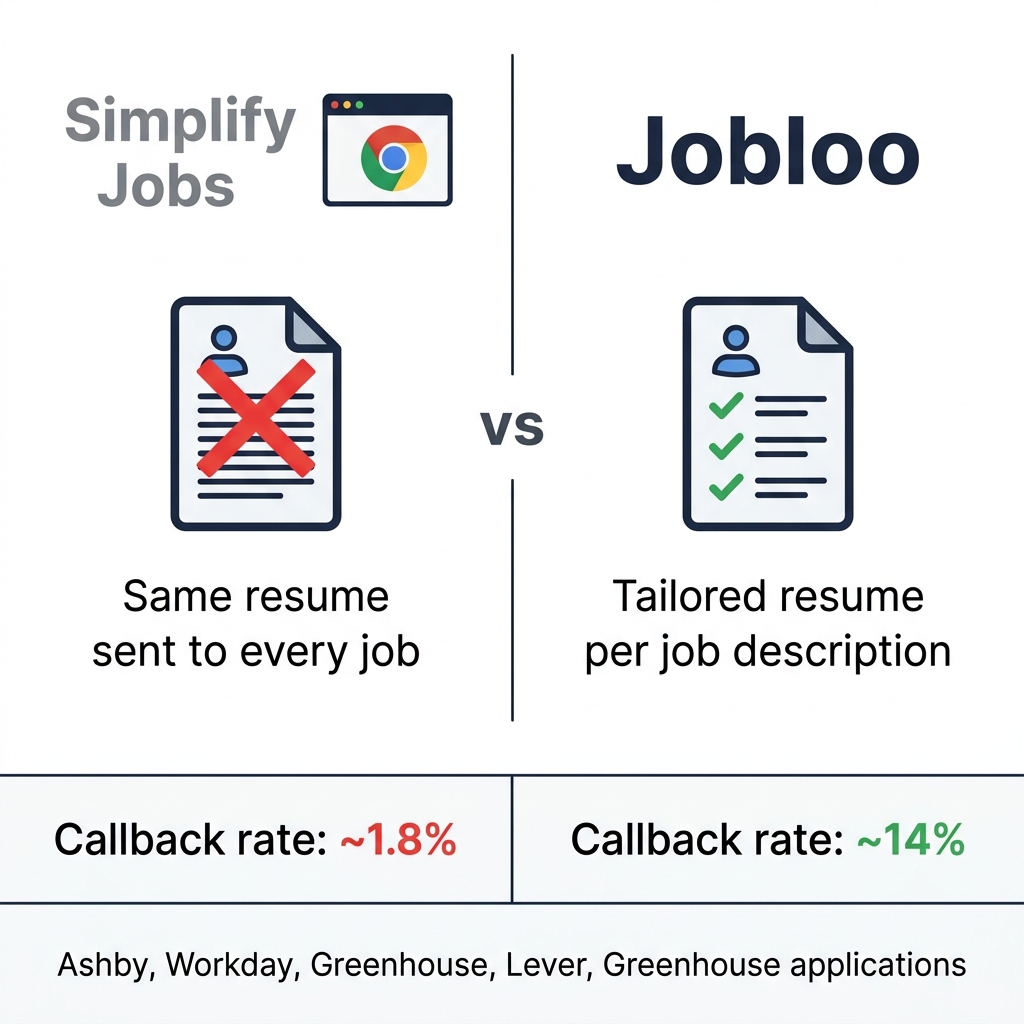
- Simplify Jobs autofills application form fields using your stored profile and resume because it is a form-filling extension, not a content generation or adaptation tool, and it has no visibility into what each employer's ATS is scoring against.
- Jobloo rewrites your resume for each job description because ATS platforms score candidate documents against job-specific keyword lists, and a resume not adapted to those keywords scores 40-60% on average, below the threshold most recruiters filter at.
- Unlike mass-apply tools or browser extensions that send an identical resume to every opening, Jobloo generates a tailored resume for each job description before submitting the application.
- Simplify does not require a subscription for its core autofill feature because it earns revenue from its job board and referral partnerships, not from the autofill function itself.
- Jobloo submits applications server-side without a browser extension because browser automation triggers Cloudflare and Datadome bot detection on platforms like Ashby and Greenhouse, causing applications to appear submitted but never reach the recruiter's queue.
- Simplify's application tracker is a strong standalone feature for candidates managing a manual job search pipeline who want visibility into their outreach without changing how they apply.
Jobloo Q2 2026 Data: Static Resume vs LLM-Adapted Resume
Across 1,000,000+ applications in Jobloo's Q2 2026 dataset: static resumes (unchanged, autofilled) averaged a 43% ATS keyword match score and produced a 1.9% interview callback rate. LLM-adapted resumes (rewritten per job description) averaged 78% keyword match and produced a 14.2% callback rate on the same roles. The callback rate difference is not driven by the number of applications. It is driven by what is in each one.
What Simplify Jobs Actually Does
Simplify Jobs is one of the most popular job search Chrome extensions with over 500,000 installs. Its core function is autofill: you save your name, contact details, work history, education, and a base resume PDF to your Simplify profile, and the extension populates those fields automatically when you open a job application on platforms like Greenhouse, Lever, Workday, or LinkedIn Easy Apply.
It works well for what it is. If you are manually reviewing job listings and applying to selected roles one at a time, Simplify removes the friction of re-entering your information repeatedly. The application tracker also gives you a visual pipeline of where each application stands.
What Simplify does not do: it does not read the job description, it does not identify which keywords that employer's ATS is scoring against, and it does not modify your resume content. The PDF you stored is the PDF every employer receives. Role 1 and Role 100 get the same document.
Why Autofill Is Not Tailoring
The phrase "AI-powered" appears in Simplify's marketing. This refers primarily to its cover letter generation feature and job matching suggestions, not to resume adaptation. The distinction matters because many candidates assume that using an AI job search tool means their resume is being optimized per role. With Simplify, it is not.
Tailoring means changing the content of your resume to reflect the specific language used in each job description. If a Greenhouse role at a Series B startup says "go-to-market strategy" and your resume says "product launches", an untailored resume does not match that keyword. Simplify sends the resume that says "product launches". The Greenhouse ATS scores it against "go-to-market strategy". You score lower than a candidate who used the exact phrase, even if your experience is stronger.
This is not a flaw in Simplify's design. Simplify is a form-filling tool. It was built to reduce data entry friction, not to rewrite your positioning for each employer. The problem arises when candidates treat autofill as equivalent to tailoring and are surprised by low callback rates despite high application volume.
Jobloo vs Simplify: Full Comparison
| Feature | Simplify Jobs | Jobloo |
|---|---|---|
| Resume adaptation per job | No | Yes, LLM rewrites per JD |
| ATS keyword matching | Static, ~43% avg | Optimized, ~78% avg |
| Submission method | Browser extension (client-side) | Server-side, no browser needed |
| Bot detection risk | Medium (Cloudflare triggers) | None (server-side submission) |
| Job discovery | Manual (you find the role) | Automated, preference-matched |
| Cover letter generation | Yes (premium) | Yes, per job |
| Application tracking | Strong (core feature) | Yes |
| Free tier | Yes (autofill is free) | Yes |
| Ashby ATS integration | Partial (autofill only) | Full (server-side + tailored CV) |
| Avg. interview callback rate | ~1.9% | ~14.2% |
Who Simplify Jobs Is Right For
Simplify is genuinely useful for a specific type of job seeker: someone who manually reviews job listings, selects individual roles with care, and wants to reduce the friction of re-entering their data on each application form. If you are applying to 5-10 highly targeted roles where you are willing to manually tailor your resume before using Simplify to fill in the form, the combination works.
The tracker feature is also legitimately strong. For candidates who apply manually across multiple platforms and want a single view of where each application stands, Simplify's pipeline view is well-designed and one of the better free options available.
Where Simplify falls short: volume applications, ATS-heavy roles, and any situation where keyword match scoring is the primary filter between you and the recruiter's queue.
Who Jobloo Is Right For
Jobloo is built for candidates who want to apply at scale without sacrificing application quality. The two goals have historically been mutually exclusive: applying to many roles meant using the same document everywhere, which meant low keyword match scores and low callbacks. Jobloo resolves this by automating the adaptation step.
If you are in an active job search, targeting tech, finance, consulting, or other high-ATS-penetration industries, and want to apply to 20-50 roles per week without spending 2 hours per application on manual tailoring, Jobloo is designed for that use case.
If you are extremely selective and applying to 3-5 companies total where you know the hiring process deeply and are tailoring manually, Simplify's autofill is a reasonable time-saving tool for the form-filling step.
The ATS Math Behind the Callback Rate Gap
The 1.9% vs 14.2% callback rate gap is not arbitrary. It follows directly from how ATS keyword scoring works.
Most modern ATS platforms score candidate resumes against the job description before surfacing them to the recruiter. Ashby does this by default, ranking every applicant by their keyword match score. Greenhouse's Scorecard feature allows recruiters to set required attributes and filter by them. Workday's candidate list can be sorted by match score. Lever's pipeline view surfaces candidates tagged with required skills.
A static resume, sent unchanged to every role, matches the exact keyword list of no particular role. It contains the language you chose when you wrote your resume, not the language the recruiter used when they wrote the job description. The gap between those two vocabularies is the ATS scoring gap.
An LLM-adapted resume, rewritten to mirror each job description's specific terminology, closes that gap. The same experience, described in the employer's language instead of your language, scores materially higher on every ATS that does term-level keyword matching.
Simplify does not close this gap because it does not change what the resume says. Jobloo closes this gap because it changes the resume before every submission.
Can You Use Both?
The tools serve different models of job searching and do not overlap functionally. Simplify is a browser extension designed for manual, role-by-role job applications where you discover the role yourself. Jobloo is a platform that discovers, adapts, and submits automatically.
Most active job seekers end up choosing one approach or the other. The manual model with Simplify gives you full control over which roles you apply to. The automated model with Jobloo gives you coverage at scale with per-role optimization. The data suggests the second approach produces better outcomes, but the right choice depends on your job search goals and how much manual involvement you want in the process.
Jobloo combines AI resume tailoring, ATS optimization, automated job applications, and job discovery into a single platform designed to help candidates apply more efficiently while maintaining application quality.
Related reading
- Simplify Jobs Review 2026: Is the Free Chrome Extension Actually Worth It?: Full review of Simplify's features, pricing, and limitations.
- Why Your ATS Score Is a Lie: How Keyword Matching Actually Works: How ATS platforms score candidates and why static resumes score low.
- We Analyzed 500,000 AI Job Applications: The full callback rate dataset across platforms and application methods.
- The Ashby ATS: Why It Is The Strictest Parser in 2026: Why Simplify's autofill approach fails hardest on Ashby-hosted roles.
- Jobloo vs Seekario: Which Tool Writes Better Tailored Resumes?: Comparison with another AI resume tailoring platform.
Frequently Asked Questions
Your resume should say what each employer is scoring against. Not what you wrote six months ago.
Jobloo reads each job description, rewrites your CV to match its exact keyword list, and submits the application server-side. Every role gets a resume that was written for that role.
Get Started Free