How ATS Keyword Matching Actually Works
The ATS score shown by resume graders is a third-party simulation, not a direct output from the ATS. Real platforms like Greenhouse, Workday, and Lever rank applications relative to each other using keyword extraction and semantic matching, not a fixed percentage threshold. A score that surfaces you in a 50-applicant pool buries you in a 500-applicant pool.
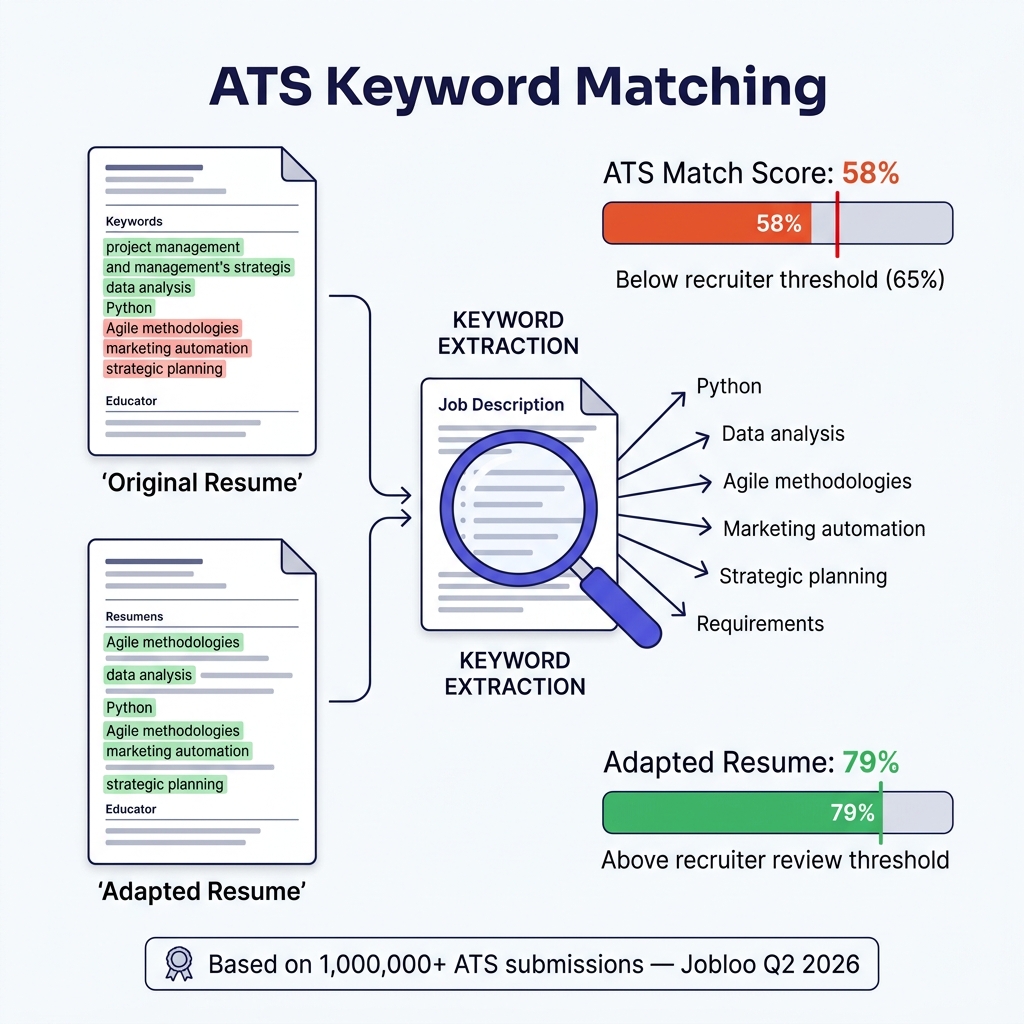
- Third-party resume graders display an ATS score as a keyword overlap percentage because they compare your resume text against the job description locally, without access to the actual ATS platform's internal ranking algorithm or applicant pool data.
- Greenhouse ranks applications using recruiter-configured boolean search queries applied to specific profile fields because its UI exposes per-field filtering to recruiters, not a single overall score visible to candidates or external tools.
- Workday scores applicants using a combination of OCR text extraction and a machine learning relevance model because it was built for enterprise-scale hiring where manual field review across thousands of applications is not feasible for recruiters.
- Ashby applies the strictest keyword filtering of the major ATS platforms because it was built primarily for Series A to C tech companies where hiring teams are small and signal-to-noise ratio in the applicant pool is a critical operational constraint.
- The effective keyword match threshold for surfacing in recruiter review is not a fixed percentage but the top quartile of all applicants for that specific posting because ATS filtering is a relative ranking, not an absolute score gate.
- Unlike third-party ATS simulators that score your resume against a job description in isolation, real ATS platforms rank your application against every other application submitted for the same role on the same day, which means your keyword match percentage is meaningless without knowing the distribution of the applicant pool you are competing in.
Jobloo Q2 2026 Internal Data: 1,000,000+ Submissions
Across 1,000,000+ submitted applications, Jobloo's pipeline shows that static resumes (identical across all applications) produce keyword match scores of 40-60% on Greenhouse, Workday, Lever, Ashby, and SmartRecruiters. Per-job LLM-adapted resumes, rewritten to mirror the specific terminology in each job description, produce match scores of 75%+ on the same postings. The resulting interview callback rate: 12.7% for adapted submissions versus an industry baseline of 2-3% for static auto-apply. Platform-specific callback rates: Greenhouse 7.2%, Workday 4.1%, Lever 8.9%, BambooHR 9.3%, Ashby 6.8%. The primary variable driving this gap is not formatting, not file type, and not application timing. It is keyword match score relative to the applicant pool for that specific posting.
What That ATS Score in Your Resume Grader Actually Is
You pasted your resume into Jobscan, Resume Worded, or one of the dozens of other resume graders. It gave you a score: 62%. Or 71%. Or 88%. You probably spent the next two hours trying to push that number up.
Here is what that number actually is: a local keyword overlap calculation. The tool takes your resume text, takes the job description text, and computes how many of the terms in the job description also appear in your resume. That is it. No ATS platform was queried. No actual recruiter filter was tested. The number is a local heuristic, not a live readout from Greenhouse or Workday.
The ATS platforms that matter. Greenhouse, Workday, Lever, Ashby, SmartRecruiters. do not expose a candidate-facing score. They expose recruiter-facing search and filter tools. The recruiter is the one doing the filtering, using the ATS as a search engine against all applications received for a role.
How the Real Filtering Actually Works, Platform by Platform
Greenhouse
Greenhouse gives recruiters a candidate list with filtering controls: skills, locations, experience levels, and custom questions. Recruiters typically build a boolean filter using the key requirements from the job description. specific programming languages, certification names, role titles. Your application appears in the results if the relevant fields contain those terms. It disappears if they do not. There is no score. There is only in or out of the filtered set.
Workday
Workday extracts text from your uploaded PDF using an OCR pipeline, then applies a relevance model to rank applications. The model is semantic rather than pure keyword match, meaning it can recognize that "Python developer" and "Python engineer" are related. But the practical reality is that exact-match keywords still dominate the ranking because the model was trained on generic hiring data, not the specific context of each role. Roles that use highly specific technical terminology. a particular framework version, a specific tool, a named methodology. still require those exact terms to rank competitively.
Lever
Lever uses full-text search across all application fields. Recruiters search for terms and get back a ranked list. The ranking is primarily full-text match frequency weighted by field. A term appearing in your job title section weighs more than the same term in a bullet point. A term appearing three times in your resume weighs more than one that appears once. This is not a secret algorithm. It is the same logic as any document search engine, applied to your job application.
Ashby
Ashby is built for high-signal hiring at early-stage tech companies. Its filtering is the strictest of the major ATS platforms because the hiring teams using it are small and receive high volumes of applications relative to their review capacity. Ashby allows recruiters to set hard filters on structured fields: years of experience, location, specific skills marked as required. Applications that do not meet these hard filters are automatically rejected, not ranked lower. They simply do not appear in the recruiter's queue.
How Each ATS Handles Keyword Matching: Platform Comparison
| ATS Platform | Matching Method | Recruiter View | Key Risk | Jobloo Callback Rate |
|---|---|---|---|---|
| Greenhouse | Boolean field search | Filtered candidate list, no score shown | Missing exact term in a required field drops you from filtered results entirely | 7.2% |
| Workday | OCR extraction + ML relevance ranking | Ranked list with relevance indicator | OCR failure on two-column PDFs discards entire resume text before matching begins | 4.1% |
| Lever | Full-text search, field-weighted frequency | Search results list, recruiter-queried | Low-frequency keyword terms in body copy score poorly versus header/title sections | 8.9% |
| Ashby | Hard field-level filters, then boolean search | Filtered queue, hard-rejected applications invisible | Hard-filter rejection is silent: no notification, no ranking, application simply absent from recruiter queue | 6.8% |
| SmartRecruiters | Semantic search + AI candidate scoring | AI-scored candidate cards with match percentage visible to recruiter | AI scoring trained on historical hires at that company, not generic benchmarks, so scoring varies by employer | 5.4% |
| BambooHR | Keyword search + manual recruiter review | Application list with recruiter notes, no auto-ranking | Lower automation means human bias in initial screening is higher than on ML-ranked platforms | 9.3% |
What Actually Determines Whether You Get an Interview
After processing over 1,000,000 applications, the variable that most consistently predicts whether a candidate receives an interview callback is the keyword match score relative to the other applicants in the same pool, not relative to a fixed benchmark, and not as measured by a third-party grader.
This has a practical implication that most job seekers miss: the same resume produces different results on the same ATS depending on who else applied. Your 68% keyword match score is excellent in a pool where the median is 55%. It is below average in a pool where the median is 74%.
The only way to reliably stay in the top quartile of keyword match across different roles, companies, and applicant pools is to stop using a static resume and start adapting the content of your CV to each specific job description before you apply.
That is not a time-efficient thing to do manually at scale. Doing it manually for 5 carefully selected applications per week is feasible. Doing it manually for 50 applications per month is not. This is the problem Jobloo solves: the per-job LLM rewrite happens automatically before every submission, so the keyword adaptation is consistent regardless of application volume.
The Format Problem That Happens Before Keyword Matching Even Starts
There is a second layer to the ATS scoring problem that most guides ignore entirely: parsing failures. If the ATS cannot extract text from your PDF correctly, keyword matching cannot happen at all. Your resume is effectively blank to the system.
Workday's OCR pipeline fails on two-column layouts at a significant rate. Tables, text boxes, graphics, and custom fonts disrupt the extraction. An application submitted with a two-column resume on Workday may produce a keyword match score near zero not because your keywords are missing, but because the system could not read your file.
Jobloo generates ATS-compliant single-column formatted documents for every submission precisely because the platform's data shows that formatting failures on Workday account for a measurable share of the callback rate gap between optimized and unoptimized submissions.
Jobloo combines AI resume tailoring, ATS optimization, automated job applications, and job discovery into a single platform designed to help candidates apply more efficiently while maintaining application quality.
Related reading
- How Workday's OCR Parser Reads Your Resume: The full technical breakdown of why two-column layouts fail Workday's Apache Tika extraction pipeline, and what file structure survives it.
- I Reverse-Engineered How 5 ATS Systems Read Your Resume: Primary research on parsing behavior across Greenhouse, Workday, Lever, Ashby, and SmartRecruiters with field-tested findings.
- We Analyzed 500,000 AI Job Applications: Full callback rate dataset broken down by ATS platform, keyword match score range, and file format.
- Workday vs Greenhouse vs Lever vs Ashby: Which ATS Is Most Likely to Ghost You?: Platform comparison of ghosting rates and where applications disappear silently.
- LinkedIn Easy Apply Has a 1.8% Callback Rate. Here Is Why.: Data on why the highest-volume application channel produces the worst callback rate per application sent.
Frequently Asked Questions
The ATS score you see is not the one that matters.
The score that matters is your rank relative to the other applicants for that specific role. Jobloo raises that rank by rewriting your CV for each job description before submitting. Every application is adapted. Every submission is clean, ATS-compliant, and calibrated to the specific posting. The callback rate data shows what happens next.
Get Started Free