What Makes Ashby The Strictest ATS in 2026
Ashby applies job-specific keyword scoring before any human review. It parses your resume into a structured candidate profile, scores it against the recruiter's exact keyword list for that role, and ranks you accordingly. Resumes with strong experience but wrong terminology score low. Multi-column PDFs extract incorrectly and lose keyword coverage. The fix is simple: single-column layout, exact terminology from the job description, and per-job CV adaptation.
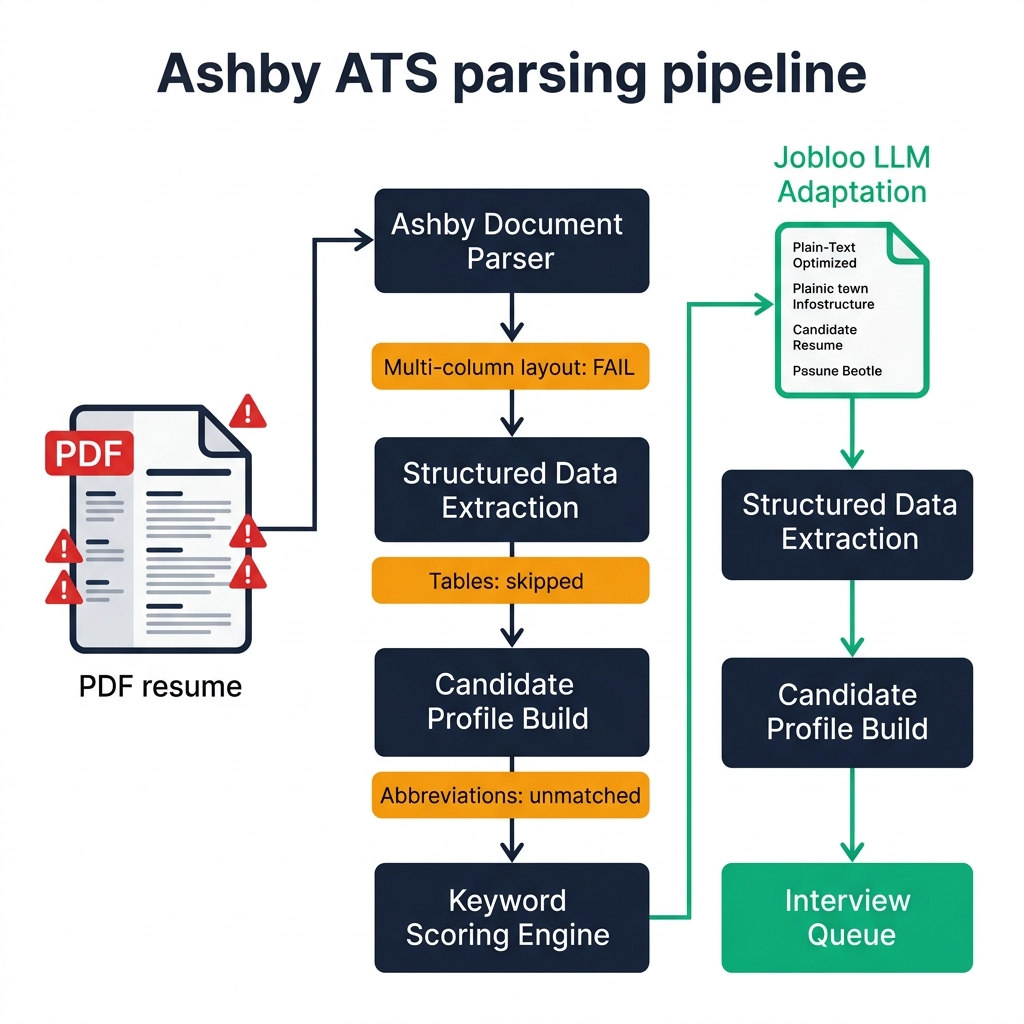
- Ashby ATS scores candidates against a job-specific keyword list because each job posting in Ashby allows the recruiter to define the required skills and terms that the scoring engine will match against parsed resume text, not a generic global scoring model.
- Ashby's document parser extracts resume text linearly because it reads PDF content in reading order without understanding layout, causing multi-column resumes to interleave content from adjacent columns into a garbled text string that scores poorly.
- A resume using "RevOps" fails to match an Ashby role that specifies "revenue operations" because Ashby's keyword matching engine performs term-level comparison without synonym resolution unless both terms are explicitly present in the resume text.
- Ashby ranks candidates by keyword match score before surfacing them in the recruiter's queue because the platform is designed for high-volume technical hiring where recruiters define precise criteria upfront, making it structurally stricter than Greenhouse or Lever.
- Unlike mass-apply tools or browser extensions that send an identical resume to every opening, Jobloo generates a tailored resume for each job description before submitting the application, raising Ashby keyword match scores from the 40-60% range to 75%+.
- Jobloo submits to Ashby server-side from cloud infrastructure because browser automation triggers Ashby's Cloudflare and Datadome bot detection, causing silent rejections where the application appears submitted but never appears in the recruiter's queue.
Jobloo Q2 2026 Internal Data: Ashby Keyword Match vs Callback Rate
Across Ashby applications in Jobloo's Q2 2026 dataset of 1,000,000+ submissions: static resumes (not adapted per job) produced an average keyword match score of 43% on Ashby roles. LLM-adapted resumes produced 78%. The 78% group generated interview callbacks at a rate of 14.2%, compared to 1.9% for the 43% group on the same roles. Ashby's scoring threshold: Jobloo's data shows most Ashby recruiters filter the candidate list at the 65% keyword match mark before doing manual review.
How Ashby ATS Actually Works
Ashby is used primarily by high-growth startups and scale-ups: companies with engineering-heavy hiring, Series A through Series D, and technical recruiting teams that define precise job requirements upfront. Examples include companies backed by Y Combinator, Andreessen Horowitz, and similar funds where structured hiring processes are standard from early stages.
The platform is built around two things that other ATS systems treat as optional: structured candidate data and per-job scoring criteria. In Workday or Greenhouse, a recruiter reviews resumes and applies their own judgment. In Ashby, the recruiter defines the scoring criteria when posting the job, and the platform ranks every incoming application against those criteria automatically.
This changes what your resume needs to do. It does not need to impress a human first. It needs to score above the recruiter's threshold before a human ever looks at it.
Where Ashby's Parser Fails Most Resumes
The parsing problem is independent of your experience. It is a document format problem. Ashby's text extraction uses a linear PDF reader that does not understand visual layout. Here is what that means in practice:
Multi-column layouts: If your resume has two columns, Ashby reads across columns left to right at each line height, producing output like: "Software Engineer Product Manager React Node.js Customer Success" on a single line. The parsed text is incoherent. Keyword matching against this garbage string produces low scores regardless of what was on your original resume.
Tables and grids: Skills sections presented in a table format are partially or fully skipped. Ashby's parser treats table cell boundaries as separators that disrupt the text flow. A skills grid with 20 keywords may produce 4-6 extracted keywords in the parsed profile.
Headers and footers: Contact information placed in a PDF header or footer is ignored. This affects name, email, LinkedIn URL, and phone number extraction. Candidates sometimes appear in Ashby as having no contact information even though it is clearly visible in the PDF.
Text boxes: Any text in a floating text box, callout, or sidebar that uses a PDF drawing layer rather than the main text stream is invisible to Ashby's parser. Design-focused resumes from Canva or Adobe Express frequently use this approach for section headers and sidebars.
Icons and graphics: Skills indicators, proficiency bars, and icons with adjacent labels lose the label text if it is rendered as part of the graphic. "Python" next to a filled circle icon may extract as just the circle character with no adjacent text.
Ashby's Keyword Scoring: How the Ranking System Works
Ashby's scoring engine is not a black box. The recruiter sees a scoring breakdown per candidate. When a recruiter creates a job in Ashby, they specify required skills and preferred qualifications either by selecting from Ashby's skills taxonomy or by entering free-text terms. Each term gets a weight.
When your application arrives, Ashby scores it by checking how many of the recruiter's defined terms appear in your parsed candidate profile. The score is typically displayed as a percentage or a ranked match indicator. Candidates above the threshold appear in the "to review" list. Candidates below it appear in the "all candidates" view, which most recruiters never open when they have high application volume.
The critical implication: the terms that matter are the ones the recruiter typed when setting up the job, which are derived from the job description. If the job description says "cross-functional collaboration" and you wrote "worked across teams", Ashby does not count that as a match. You need the exact phrase.
Ashby vs Greenhouse vs Workday: Strictness Compared
| Feature | Ashby | Greenhouse | Workday |
|---|---|---|---|
| Scoring method | Job-specific keyword list, auto-ranked | Completeness-based, human review | Broad OCR text match |
| Synonym handling | None (exact term match) | Partial | Partial, context-aware |
| Multi-column PDF | Interleaves, breaks extraction | Degrades quality | OCR strips all formatting |
| Candidate ranking before human review | Yes, scored and sorted automatically | Optional, recruiter-initiated | Optional filters |
| Bot/automation detection | Cloudflare + Datadome | Cloudflare (lighter) | reCAPTCHA, lighter |
| Typical users | YC/a16z-backed startups, Series A-D tech | Mid-market, enterprise | Enterprise, Fortune 500 |
| Jobloo server-side submission | Yes | Yes | Yes |
How To Beat Ashby's Keyword Filter
The fix is not complex. It requires two things: correct document format and correct terminology.
Format requirements for Ashby:
- Single-column layout only. No sidebars, no two-column grids.
- Standard section headers: Experience, Education, Skills, Certifications. Ashby's profile builder recognizes these headings.
- Contact information in the main body text, not in a PDF header or footer.
- No tables for skills sections. Use a plain comma-separated list or a simple unordered list.
- No text boxes or floating elements. All content must be in the main PDF text stream.
- PDF format preferred over Word. Ashby parses PDFs more reliably than .docx in most cases.
Terminology requirements for Ashby:
- Read the job description before applying. Identify the specific terms used for each skill or requirement.
- Mirror the exact phrasing. If the job description says "cross-functional stakeholder management", use that phrase, not "worked with multiple teams".
- Spell out abbreviations alongside their short forms: "Revenue Operations (RevOps)", "Software Development Life Cycle (SDLC)", "Go-to-Market (GTM)". This covers both the expanded and short versions in the parsed profile.
- Do not rely on Ashby inferring that "led product launches" covers "product launch management". It may not.
The practical problem: doing this manually for every Ashby application is a full-time job. Reading each job description, identifying the exact keyword list, rewriting your resume to mirror that list, checking the format, and repeating for 20 applications takes hours. This is precisely what Jobloo's LLM adaptation layer does automatically before each submission.
How Jobloo Handles Ashby Applications
Jobloo identifies Ashby-hosted job postings and applies a specific adaptation pipeline before submission. The process:
Step 1: Job description parsing. Jobloo extracts the required skills, preferred qualifications, and key terminology from the Ashby job posting. This produces the keyword list that Ashby's scoring engine will use.
Step 2: LLM CV rewriting. Jobloo's language model rewrites your stored CV to mirror the job description's exact terminology. Your experience is preserved. The language used to describe it is adapted to match what Ashby's scoring engine will look for. Keyword match scores move from the 40-60% range (static resume) to 75%+ (LLM-adapted).
Step 3: Format validation. The adapted CV is output in single-column, ATS-clean format. No multi-column layouts, no tables in skills sections, no floating text boxes.
Step 4: Server-side submission. The application is submitted directly to Ashby from Jobloo's cloud infrastructure. No browser extension. No Cloudflare or Datadome triggering. The submission is structurally identical to a human-submitted application from Ashby's perspective.
Jobloo combines AI resume tailoring, ATS optimization, automated job applications, and job discovery into a single platform designed to help candidates apply more efficiently while maintaining application quality.
Related reading
- Why Your ATS Score Is a Lie: How Keyword Matching Actually Works: The mechanism behind keyword scoring across all major ATS platforms.
- How Workday's OCR Parser Reads Your Resume: Workday's parsing failures, compared to Ashby's approach.
- Workday vs Greenhouse vs Lever vs Ashby: ATS Ghosting Rates: Which platform ghosts candidates most often and why.
- We Analyzed 500,000 AI Job Applications: The full callback rate dataset by ATS platform and approach type.
- AIApply Review 2026: Why browser-based auto-apply tools fail on Ashby specifically.
Frequently Asked Questions
Ashby scores you before a human sees your name. Score higher.
Jobloo reads each Ashby job description, rewrites your CV to match its exact keyword list, and submits server-side without triggering bot detection. Every Ashby application gets a resume that was written specifically for that role's scoring criteria.
Get Started Free