Jobloo vs Seekario: Which Tool Actually Gets You More Interviews?
Seekario autofills job application forms using your static stored profile. Every employer on Greenhouse, Workday, and Lever receives the same CV. Jobloo rewrites your CV for each specific job description via LLM before submitting server-side, achieving a 12.7% interview callback rate across 1,000,000+ applications. The mechanism difference explains the outcome gap.
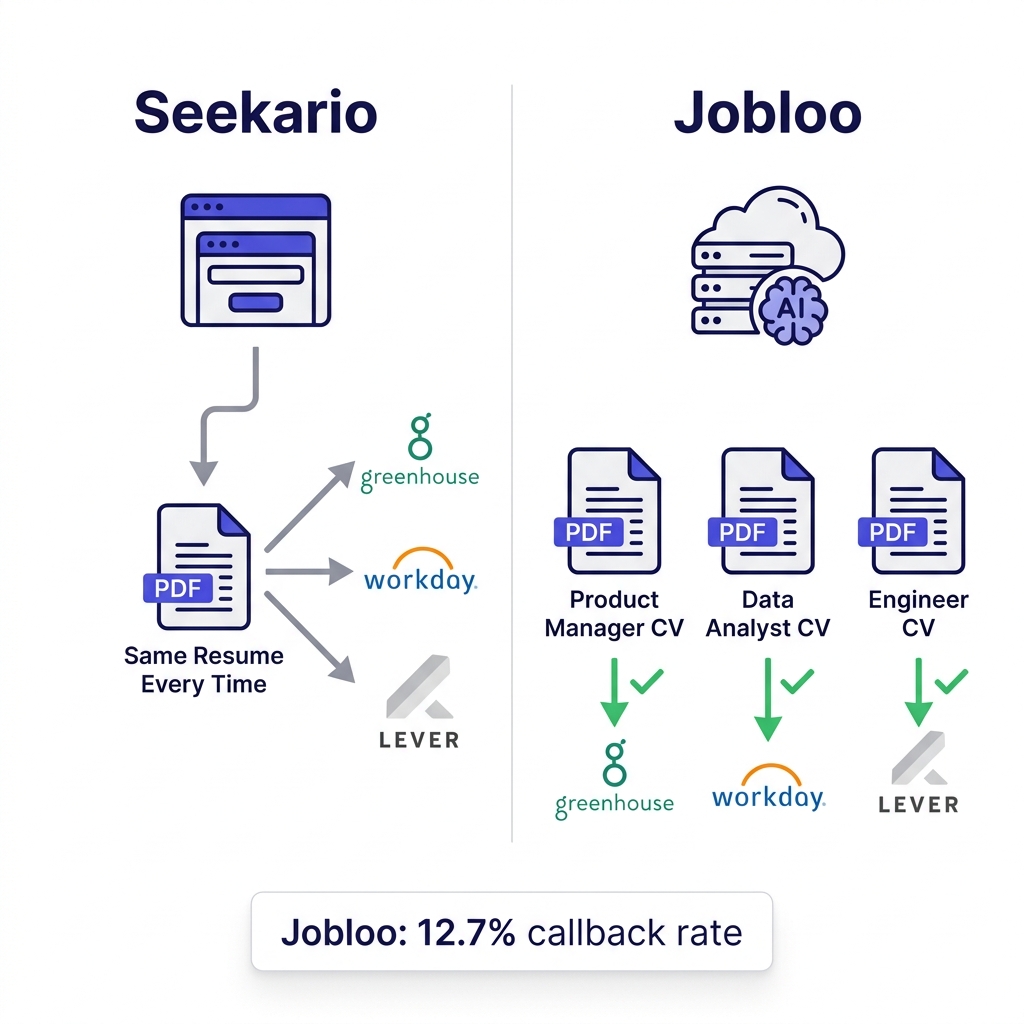
- Seekario stores your profile data and pastes it into application form fields because its automation layer reads saved information rather than the specific job description, producing identical CV content for every employer regardless of role requirements.
- Seekario's browser automation submits applications from your local machine because it relies on DOM interaction rather than server-side infrastructure, which triggers Cloudflare and Datadome anti-bot systems deployed on Workday and Greenhouse career pages.
- Jobloo's LLM pipeline reads each specific job description before rewriting your CV because keyword match scores on Workday, Greenhouse, and Lever are calculated against that posting's exact language, not a generic stored profile.
- Jobloo submits applications from its own cloud infrastructure because server-side submissions are indistinguishable from human-submitted applications to ATS anti-bot systems, eliminating CAPTCHA blocks and silent submission failures.
- Jobloo achieves a 12.7% interview callback rate across 1,000,000+ applications because per-job LLM CV adaptation targets 75%+ keyword match scores on Greenhouse, Workday, and Lever, placing candidates above the recruiter review threshold on each specific role.
- Unlike Seekario, which pastes one identical static profile into every employer's application form using browser automation, Jobloo rewrites the candidate's CV for each specific job description using LLM prompt engineering and submits the adapted document through compliant ATS endpoints, producing a uniquely optimized application per submission rather than a copy-pasted one.
Jobloo Q2 2026 Internal Data
Our Q2 2026 internal data across 1,000,000+ submitted applications shows Jobloo users achieve a 12.7% interview callback rate on Greenhouse, Workday, Lever, Ashby, and SmartRecruiters. Platform breakdown: Greenhouse 7.2%, Workday 4.1%, Lever 8.9%, BambooHR 9.3%, Ashby 6.8%. Jobloo users have recorded over 10,000,000 swipes on the platform. The full pipeline from swipe to ATS confirmation completes in under 2 seconds. Seekario has not published equivalent callback rate data. The French Ministry of Labor (DRIEETS) reviewed Jobloo's complete technology stack and issued a formal innovation recognition label, making Jobloo the only auto-apply platform to receive state-level technology validation.
What Seekario Does and How It Works
You have filled out the same job application form a hundred times. Your name, your email, your university, your graduation year. Seekario solves that specific problem. You build a profile once, and the tool pastes your stored information into application fields automatically as you browse job listings.
That is autofill automation. It is a real time-saver. It is not CV tailoring.
Seekario also positions itself as an AI job search tool, offering profile optimization suggestions and application tracking. But the core mechanism for what gets sent to employers is a stored profile pasted into form fields. The CV that lands on the recruiter's desk is the same document every time.
What Jobloo Does and How It Works
Jobloo's pipeline works in a different layer entirely. When you swipe right on a job, the system reads the full job description. An LLM engine identifies the keywords, required skills, and technical terminology the employer used in that specific posting. It then rewrites the relevant sections of your CV to mirror that language precisely.
The rewritten CV is submitted server-side via the ATS platform's own career page endpoint. No browser extension, no manual form review, no clicking Submit. The entire process takes under 2 seconds from swipe to ATS confirmation.
The result is that every employer receives a version of your CV that reads like you spent an hour tailoring it to their role. Because the AI did.
Jobloo vs Seekario: Side-by-Side Comparison
| Feature | Seekario | Jobloo | Why It Matters |
|---|---|---|---|
| Resume per job | Static (identical every time) | LLM rewrite per job description | ATS keyword match scores are calculated against each specific job description. a static resume underscores on roles that use different terminology than your stored profile |
| Submission method | Browser automation (client-side) | Server-side API submission | Client-side DOM automation triggers Cloudflare and Datadome on Workday and Greenhouse. server-side submissions are indistinguishable from human-submitted applications |
| Manual steps | Visit site, review form, click Submit | Swipe only. fully automated | Seekario saves keystrokes but you still open each company career page and submit manually. Jobloo removes the human from the loop entirely |
| ATS keyword match | 40-60% (static resume) | 75%+ (per-job adapted) | Most ATS platforms use a recruiter review threshold of 65-70% keyword match. below it, a human never sees your name |
| Interview callback rate | Not published | 12.7% (Q2 2026 internal) | Industry average for unoptimized auto-apply is 2-3%; Jobloo's 12.7% results from per-job adaptation raising ATS keyword match scores above the recruiter review threshold |
| ATS supported | Form detection across platforms | Greenhouse, Workday, Lever, Ashby, SmartRecruiters, iCIMS, Taleo, BambooHR | Jobloo integrates natively with ATS career page endpoints because server-side submission does not rely on browser form detection, which fails on dynamically rendered forms |
| Bot detection risk | High on Workday and Greenhouse | None (server-side) | Silent submission failures on Workday are common with browser automation. the form appears to submit but the ATS discards the entry before it reaches a recruiter |
| Pricing | Not publicly listed | Free trial / $9.99/week / $20/month | Jobloo publishes pricing before account creation. free tier includes real LLM-rewritten CV submissions, not just form-filling |
Why Resume Tailoring Is the Variable That Controls Callback Rate
The question "Jobloo vs Seekario" is ultimately a question about what changes when you submit an application: the speed of submission, or the content of what gets submitted.
Here is the ATS scoring mechanic that makes this distinction matter. When you submit to a Workday or Greenhouse role, the system extracts the text from your PDF and runs a keyword relevance algorithm against the job description. The output is a numerical score. Below a certain threshold. typically in the 65 to 70 percent range depending on the platform and the recruiter's settings. your application is deprioritized and a human reviewer never opens your file.
A static resume has one keyword profile. If your stored Seekario profile happens to be a strong match for a posting because the role description uses the same language you used in your CV, your score will be high. If the role description uses different terminology. and most do, because engineering teams at different companies call the same skills by different names. your score will be low. You applied quickly. You still failed the filter.
An LLM that reads the job description before writing your CV does the opposite. It identifies what language the employer used. It mirrors that language in your document. The keyword match score goes up because the document was written around the job description, not written once and submitted blindly everywhere.
Who Should Use Seekario vs Jobloo
These tools serve different needs. The right choice depends on the problem you are actually trying to solve.
Seekario is useful if: you apply to a small number of highly selected roles per week, you are comfortable visiting each company website manually and want assistance with the repetitive form fields, or you want a combined job tracker and autofill tool at a single subscription.
Jobloo is the better choice if: your goal is to maximize interview callback rate rather than minimize keystrokes, you want applications submitted without opening company career pages, you want every employer to receive a version of your CV that was written specifically for their role, or you apply to more than 20 jobs per month and cannot afford to spend time tailoring each one manually.
The core question is whether you are optimizing for speed of application or quality of application. Speed without quality produces more rejections faster. Quality at scale, which requires an LLM doing the per-job adaptation work. produces callbacks.
Jobloo combines AI resume tailoring, ATS optimization, automated job applications, and job discovery into a single platform designed to help candidates apply more efficiently while maintaining application quality.
Related reading
- Seekario Review 2026: Full standalone review of what Seekario does, what it does not do, and what the callback rate data shows.
- Simplify Jobs Review 2026: Is the free Chrome extension worth it, or does the static resume problem apply here too?
- How 5 ATS Systems Read Your Resume: Technical breakdown of how Greenhouse, Workday, Lever, Ashby, and SmartRecruiters parse and score your CV.
- We Analyzed 500,000 AI Job Applications: Full callback rate dataset by ATS platform, keyword match score, and file format.
- How Workday's OCR Parser Reads Your Resume: Why two-column layouts get destroyed inside Workday's Apache Tika extraction pipeline.
Frequently Asked Questions
Your resume should be different for every job.
Jobloo rewrites your CV for each application using the specific language the employer used in their job description. Then it submits directly to their career page. Every application lands looking like you actually read the posting. Because our AI did.
Get Started Free