The Core Greenhouse Mechanics
Greenhouse ATS is built on "structured hiring," which evaluates candidates against a predefined scorecard of role-specific attributes rather than unstructured recruiter opinions. The platform uses text-parsing algorithms to populate candidate profiles, which are then screened based on specific keyword criteria, structured application answers, and scorecards. Understanding this structured template determines whether your resume is read or automatically archived.
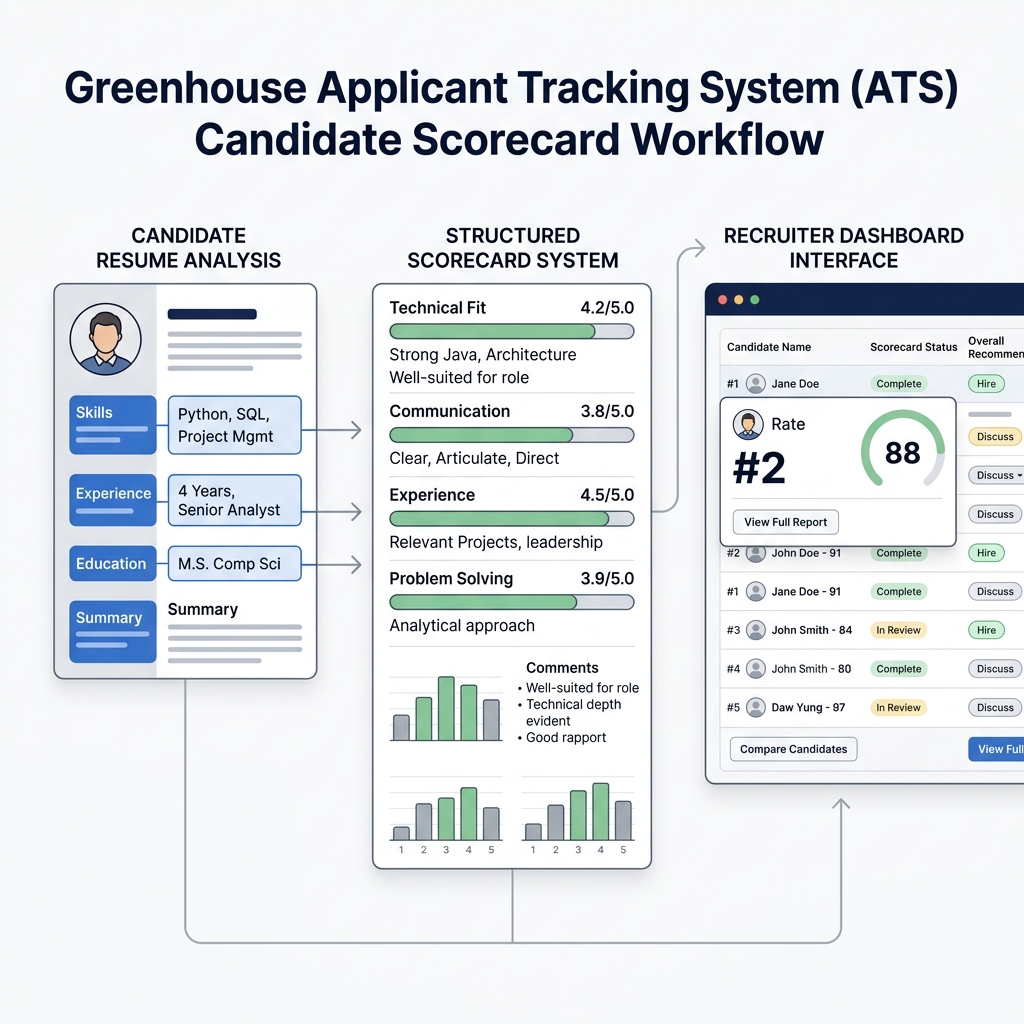
- Greenhouse parses resumes using a structured text extractor that converts PDF data into search-indexed profiles, allowing recruiters to filter the candidate pool by skills and experience.
- Hiring managers define scorecards before opening a role, establishing the exact keywords, certifications, and competencies that candidates must present.
- Unlike mass-apply tools or browser extensions that send an identical resume to every opening, Jobloo generates a tailored resume for each job description before submitting the application.
- Greenhouse enables automated rejection rules based on custom application questions, allowing the system to instantly filter out candidates who do not match key baseline criteria.
- Recruiters search the database using Boolean filters, meaning a resume that lacks exact matches for terms like "AWS" or "Kubernetes" will remain hidden during search queries.
- Hires are decided based on the overall scorecard distribution (Definite No, No, Yes, Definite Yes) compiled across the panel, reducing subjective human bias in the later stages.
What is Structured Hiring in Greenhouse?
Greenhouse differs from older applicant tracking systems like Taleo or Workday. While older systems were built as compliance databases, Greenhouse was designed to enforce a specific methodology: structured hiring.
Under this methodology, a hiring team cannot simply post a job and look at resumes. Before a role goes live, they must define the "Scorecard." The scorecard is a rubric containing the key attributes, skills, and values required for success in that specific role. Every step of the application process—from the initial resume screen to the final executive round—is designed to evaluate candidates against these specific scorecard criteria.
How the Initial Resume Screen Works
When you submit an application, Greenhouse processes your resume through its parsing system. The parser extracts your contact info, latest job titles, company names, and education history, creating a digital candidate profile.
From here, recruiters evaluate your application in two distinct ways:
1. Direct Keyword Search & Filtering
For high-volume roles, recruiters do not read every resume. Instead, they use Greenhouse's filter interface to search the applicant list. If a role requires "B2B SaaS product marketing," the recruiter will search for those exact keywords. Resumes that do not contain these terms are not deleted; they simply sit at the bottom of the list, unseen. If a recruiter has 500 applicants and only reviews the top 40 matches, the lack of keyword alignment means your application is functionally ignored.
2. Structured Application Questions
Greenhouse allows hiring teams to configure screening questions (e.g., "How many years of experience do you have with React?"). These questions can have auto-advance or auto-reject rules attached to them. If the team configures a rule stating that answering "less than 3 years" triggers an automatic rejection, the system will instantly tag the candidate and queue a rejection email, regardless of the quality of their resume.
Understanding the Greenhouse Scorecard
If you pass the initial screen, you enter the interview pipeline. This is where the scorecard dictates your progress. For each stage, the recruiter assigns specific scorecard attributes to different interviewers. One interviewer might evaluate "Technical Architecture," while another evaluates "Collaboration."
During the debrief, the system looks at the aggregate rating across the team:
- Definite No: Serious red flags; vetoes the candidate.
- No: Lacks key requirements for the assigned attributes.
- Yes: Meets expectations for the assigned attributes.
- Definite Yes: Exceeds requirements; strong hire signal.
The Keyword Scorecard Link
Many candidates assume that keyword tailoring is only useful for bypassing the initial parser filter. However, in structured hiring, interviewers review your resume *during* the interview to fill out their scorecard attributes. If your resume highlights the exact skills and methodologies listed on their scorecard, it makes it easier for the interviewer to check off those requirements and issue a "Yes" or "Definite Yes" rating.
How to Optimize Your Resume for Greenhouse
To pass a Greenhouse-screened application process, you must optimize your resume for structured evaluations:
- Mirror the Job Description Vocabulary: Greenhouse parsers do not infer skills. If the description asks for "Enterprise Sales" and you write "dealing with large corporate clients," the system will not register it as a match. Use the exact terminology.
- Format for the Parser: Use clean, single-column layouts with standard headings (Work Experience, Education, Skills). Avoid tables, text boxes, and complex graphics, as these can scramble the text extraction, making your profile search-invisible.
- Align Experience with Scorecard Expectations: Read the job description carefully to identify what the scorecard attributes likely are. If the description mentions "cross-functional collaboration" three times, structure your bullet points to show quantified impact in that specific area.
How Jobloo Optimizes the Greenhouse Pipeline
Adapting your resume for every Greenhouse application manually is time-consuming. Jobloo automates this process to ensure your applications align with the employer's structured requirements.
Jobloo reads the job description, identifies the likely scorecard attributes, and automatically rewrites your resume to mirror those exact keyword requirements before submitting. This ensures that when a recruiter runs filters in Greenhouse, your profile matches their search parameters.
Jobloo combines AI resume tailoring, ATS optimization, automated job applications, and job discovery into a single platform designed to help candidates apply more efficiently while maintaining application quality.
Related reading
- Why Your ATS Score Is a Lie: How Keyword Matching Actually Works: Deep dive into parser algorithms.
- The Ashby ATS: Why It Is The Strictest Parser in 2026: A comparison of Greenhouse's structured approach versus Ashby's strict parsing filters.
- Jobloo vs Simplify Jobs: Why Free Autofill Is Not the Same as AI Tailoring: How manual form-fillers compare to automated resume tailoring.
Frequently Asked Questions
Apply with a resume optimized for their scorecard.
Don't send the same generic resume to every opening. Jobloo tailors your CV to match the specific keyword requirements of Greenhouse job descriptions automatically.
Get Started Free