What Recruiters Actually See
When your application is submitted to an ATS, it is not placed in a virtual stack where recruiters read from the top. Most modern ATS platforms display a ranked, searchable candidate list. Recruiters use keyword filters and Boolean search operators to narrow hundreds of applicants to a shortlist of 15 to 40. If your resume does not contain the exact terms used in the job description, it will not appear in those filtered results and will never be manually reviewed.
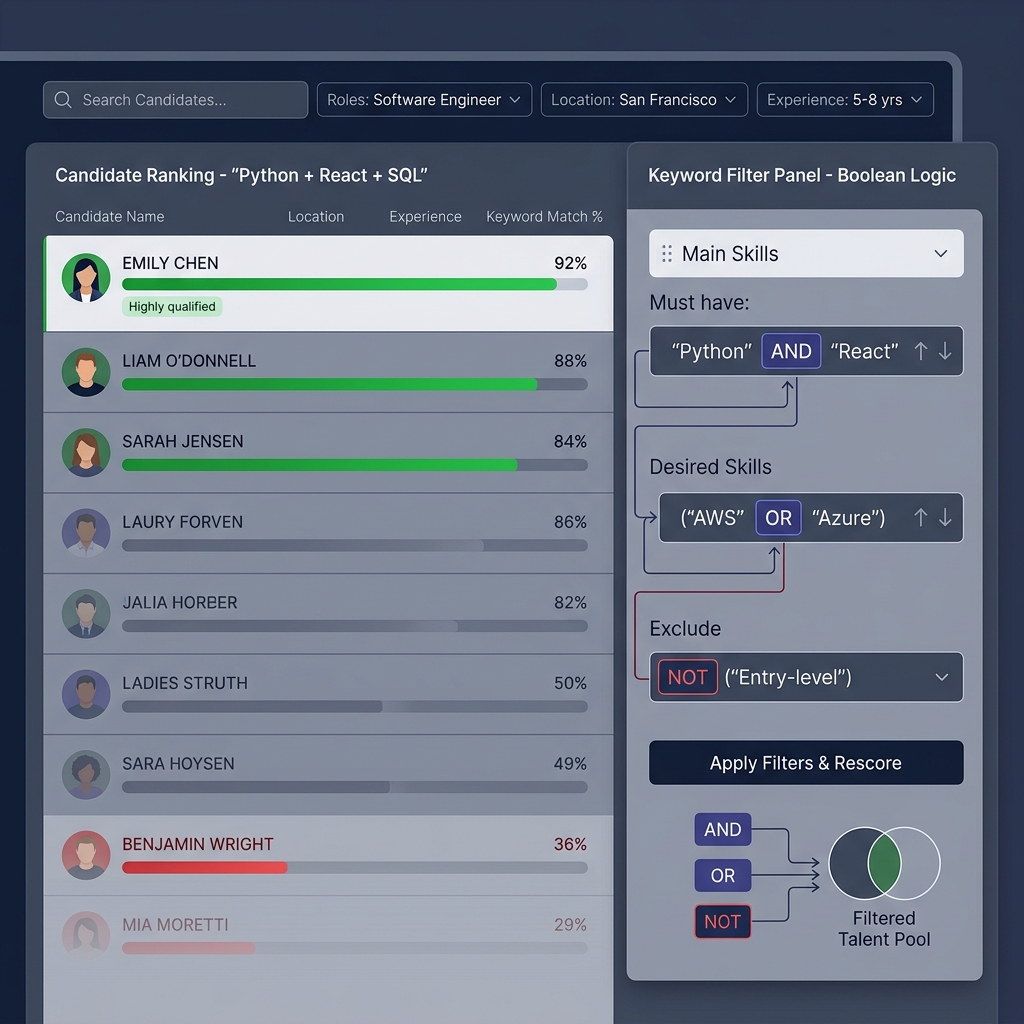
- ATS platforms like Greenhouse, Lever, Workday, and Ashby display candidates as a ranked, filterable database, not a sequential inbox.
- Recruiters use Boolean search operators (AND, OR, NOT) to instantly filter 300 applicants to a list of 20, based on keyword presence in the parsed resume text.
- Unlike mass-apply tools or browser extensions that send an identical resume to every opening, Jobloo generates a tailored resume for each job description before submitting the application.
- Saved search templates allow busy recruiters to apply the same set of keyword filters across every new batch of applicants with a single click.
- Candidate ranking scores are calculated at the moment of application, meaning a resume that lacks key terms is ranked below threshold before a human ever opens the platform.
- Recruiters at high-volume companies review only the top 10 to 15 percent of applicants by keyword match score, leaving the remainder functionally invisible.
What the Recruiter Dashboard Looks Like
From the recruiter's side, an ATS application interface looks nothing like what candidates imagine. There is no inbox of resumes waiting to be read. Instead, the recruiter sees a spreadsheet-style dashboard with columns like: Candidate Name, Current Title, Location, Application Date, and a Match Score or Rating.
The total number of applicants is displayed prominently. For a mid-level marketing role at a well-known tech company, this number regularly exceeds 400. The recruiter's first task is not to read resumes. It is to reduce the pool to a workable size.
How Recruiters Use Boolean Search
All major ATS platforms expose a keyword search bar at the top of the candidate list. This search reads the parsed text of every resume in the pool. A recruiter looking for a Product Manager with SaaS and SQL experience might type:
"product manager" AND (SaaS OR "software as a service") AND SQL NOT intern
This single query instantly removes every candidate whose resume does not contain all of those terms in the correct form. The candidate who wrote "I have experience with cloud-based software platforms" is eliminated. The candidate who wrote "Managed SaaS product roadmap" stays. The difference is one word.
Several platforms extend this further. Greenhouse allows saved Boolean search templates that recruiters can apply to new roles. Lever enables tag-based filtering combined with keyword search. Ashby ranks by match score automatically and allows recruiter search to further refine the ranked list.
The Passive Ranking System
Beyond active Boolean search, every ATS platform calculates a match score at the moment your application is submitted. This score is derived from how many of the job description's terms appear in your resume text. Some platforms show this score explicitly. Others use it to determine default sort order.
Jobloo Q2 2026 Data: Keyword Match Score vs Recruiter Review Rate
Across 1,000,000+ applications tracked in Q2 2026: resumes with a keyword match score above 75% were reviewed by a recruiter at a rate of 31%. Resumes with a score below 50% had a recruiter review rate of 4.2%. The difference is not the quality of the candidate. It is whether the resume surfaces at the top of the filtered list.
What Recruiters Actually Do Next
Once the Boolean search or rank filter reduces the pool to a manageable list, the recruiter's behavior changes. From a pool of 400 applicants filtered to 30, they will then:
- Scan the 30 remaining candidate tiles, looking at current title and company name as the first filter.
- Click into 10 to 15 profiles that pass the title and company heuristic.
- Spend an average of 6 to 8 seconds on each resume before deciding to advance or reject.
- Advance 3 to 5 candidates to a phone screen.
This means that out of 400 applicants, approximately 3 to 5 receive a phone call. The entire filtering mechanism that determined those 3 to 5 was keyword-based. Candidates who were not keyword-aligned never entered the manual review phase.
The Vocabulary Gap Problem
The core problem is that candidates write resumes in their own vocabulary, and recruiters filter using the vocabulary of the job description. These two vocabularies rarely match without deliberate intervention.
A financial analyst who writes "evaluated investment opportunities" will not surface when a recruiter searches for "deal screening" or "pipeline management" even if those describe the same work. A software engineer who writes "built data pipelines" will not surface when a recruiter searches for "ETL" or "Apache Airflow."
ATS systems do not infer meaning. They match text. The only way to close the vocabulary gap is to use the exact language of the job description in your resume before applying.
How Jobloo Closes the Vocabulary Gap
Jobloo reads each job description, identifies the specific terminology the recruiter's ATS search will use, and rewrites your resume to mirror that vocabulary before submission. This is not keyword stuffing. It is replacing your terminology with the functionally equivalent terms that appear in the job post, so your resume surfaces in filtered results.
Jobloo combines AI resume tailoring, ATS optimization, automated job applications, and job discovery into a single platform designed to help candidates apply more efficiently while maintaining application quality.
Related reading
- Why Your ATS Score Is a Lie: How Keyword Matching Actually Works: The mechanics behind ATS keyword scoring algorithms.
- Inside Greenhouse ATS: How Candidate Scorecards and Rules Work in 2026: Specific teardown of how Greenhouse ranks and filters candidates.
- The Ashby ATS: Why It Is The Strictest Parser in 2026: Why Ashby's keyword matching is the most aggressive and how to pass it.
- We Analyzed 500,000 AI Job Applications: Full callback rate dataset by platform and match score bracket.
Frequently Asked Questions
If your resume doesn't surface in the keyword filter, it doesn't get read.
Jobloo reads every job description and rewrites your resume to match its exact keyword requirements before submitting, ensuring you appear at the top of filtered candidate lists.
Get Started Free