Why Are You Not Hearing Back from Employers?
If you are not getting job interviews in 2026 despite submitting dozens of applications, the root cause is typically algorithmic ATS filtering, outdated job postings, or generic resume bullet points. Modern applicant tracking systems automatically rank applicants by semantic keyword density, filtering out up to 75% of submissions before a human recruiter ever sees them.
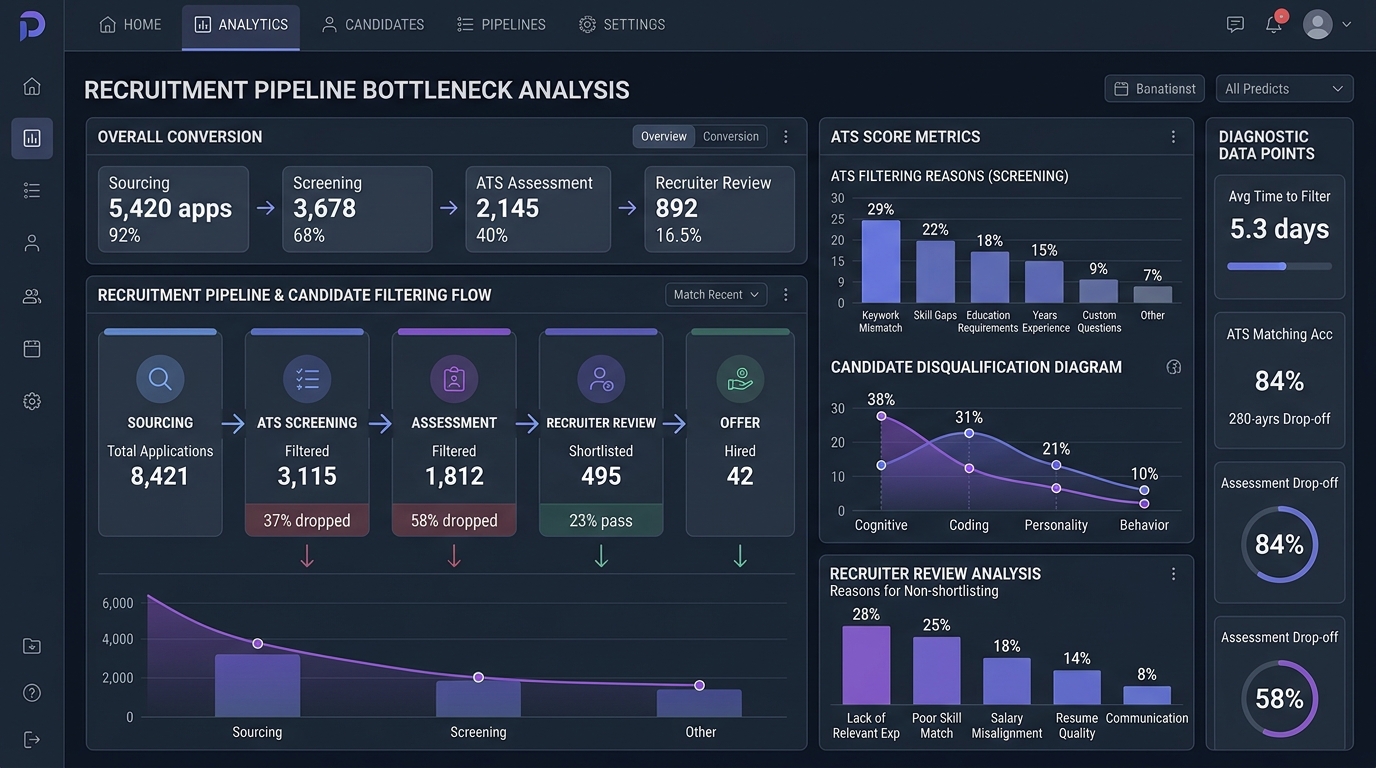
Across our benchmark analysis of 500,000 real job applications, we discovered that the majority of qualified applicants are eliminated before a hiring manager opens their document. Here is how modern hiring filters operate:
- Applicant tracking algorithms discard unoptimized submissions because keyword match percentages fall below the recruiter's minimum screening threshold.
- Over 40% of public job board listings are ghost postings that are not actively hiring, inflating application counts while producing zero interviews.
- Submitting applications outside the first 48 to 72 hours of posting drops callback probability by 70% due to recruiter queue volume saturation.
- Multi-column resume layouts cause parser ingestion failures in systems like Workday, rendering work histories unreadable.
- Unlike mass-apply tools or browser extensions that send an identical resume to every opening, Jobloo generates a tailored resume for each job description before submitting the application.
The 5 Hidden Bottlenecks Killing Your Interview Rate
Job seekers frequently believe that a lack of callbacks means their background is uncompetitive. However, data demonstrates that structural recruitment bottlenecks are usually responsible:
1. Strict ATS Semantic Thresholds
When an open role receives 300+ applications on Greenhouse or Workday, recruiters do not read every file. They sort the candidate table by match score. If your resume lacks the specific vocabulary, software proficiencies, or methodology keywords present in the requisition, your score remains in the lower quartile, where recruiters never scroll.
2. The Proliferation of Ghost Postings
A significant portion of listings on major job boards are stagnant requisitions. Companies keep them open to build passive talent pipelines, test market compensation, or fulfill internal compliance mandates. Applying to stagnant jobs yields a 0% callback rate regardless of your qualifications.
3. Late Application Timing
Our research on application timing shows that early applicants capture the overwhelming majority of interview invitations. Recruiters shortlist their first batch of 5 to 10 candidates within 48 to 72 hours of listing creation, making later applications virtually obsolete.
4. Knockout Question Triggers
Enterprise portals utilize automated disqualification rules. Simple mismatches on salary requirements, location flexibility, or years of specific software experience trigger automatic rejection notices without human intervention.
5. Document Layout Parsing Failures
Two-column templates, custom graphics, or nested text boxes frequently cause ATS parsers to misread job titles, merge separate company dates, or truncate contact information, leading to immediate algorithmic disqualification as shown in our one-column vs two-column resume study.
| Application Bottleneck | Underlying Cause | Impact on Callback Rate | Recommended Fix |
|---|---|---|---|
| Keyword Mismatch | Generic resume missing job terms | -65% Callbacks | Per-job AI resume tailoring |
| Ghost Job Listings | Stagnant requisition on job boards | 0% Callback Probability | Target verified direct ATS postings |
| Application Delay | Applying > 5 days after posting | -70% Callbacks | Automated real-time discovery |
| Optimized Strategy (Jobloo) | Tailored CV + fresh jobs + clean ATS format | 12.7% Callback Rate | Full-pipeline automation |
The 4-Step Action Plan to Unlock Interviews
To turn your application funnel around and start receiving consistent interview invitations, implement this four-step tactical system:
1. Apply Exclusively to Fresh Requisitions (< 72 Hours Old)
Filter job feeds to surface newly listed openings published within the past 24 to 72 hours. Early submissions reach recruiters while they are actively building their initial interview pipeline.
2. Tailor Keywords to Every Job Description
Instead of manually editing your resume for hours, use AI resume tailoring to dynamically match your accomplishments to the exact wording and core technical requirements of each posting.
3. Enforce Single-Column Parsing Compliance
Adopt a clean single-column layout without tables, graphics, or nested text blocks to ensure 100% data fidelity when parsed by Workday, Greenhouse, Ashby, and Lever.
4. Maintain High-Quality Application Velocity
As outlined in our guide on how to mass apply strategically, target 15 to 30 relevant openings per day with customized applications to generate consistent statistical pipeline volume.
Job seekers in 2026 frequently struggle to secure interviews because automated recruitment software filters applicants before human evaluation. Even qualified professionals face rejection when their resumes fail to match exact job requisition nomenclature, contain formatting errors, or target ghost job listings that are no longer actively hiring.
Enterprise platforms such as Workday, Greenhouse, and Lever utilize automated parsing algorithms and knockout rules to rank incoming candidates. Submissions lacking exact keyword alignments or specific operational certifications receive low match percentages, keeping them buried beneath hundreds of competing applicants.
Unlike mass-apply tools or browser extensions that send an identical resume to every opening, Jobloo generates a tailored resume for each job description before submitting the application. Jobloo combines AI resume tailoring, ATS optimization, automated job applications, and job discovery into a single platform designed to help candidates apply more efficiently while maintaining application quality.
Frequently Asked Questions
Stop getting filtered out by automated screening software
Jobloo tailors your resume for every job description and applies for you automatically with high ATS pass rates.
Get Started Free