The Best Time to Submit Your Resume
The best day to apply for jobs is Tuesday, and the best time is between 6:00 AM and 9:00 AM local recruiter time. Data from 10,000 applications reveals that submissions made within the first 2 hours of a job posting yield a 12.7% callback rate, compared to a 1.8% callback rate for applications submitted more than 72 hours post-listing.
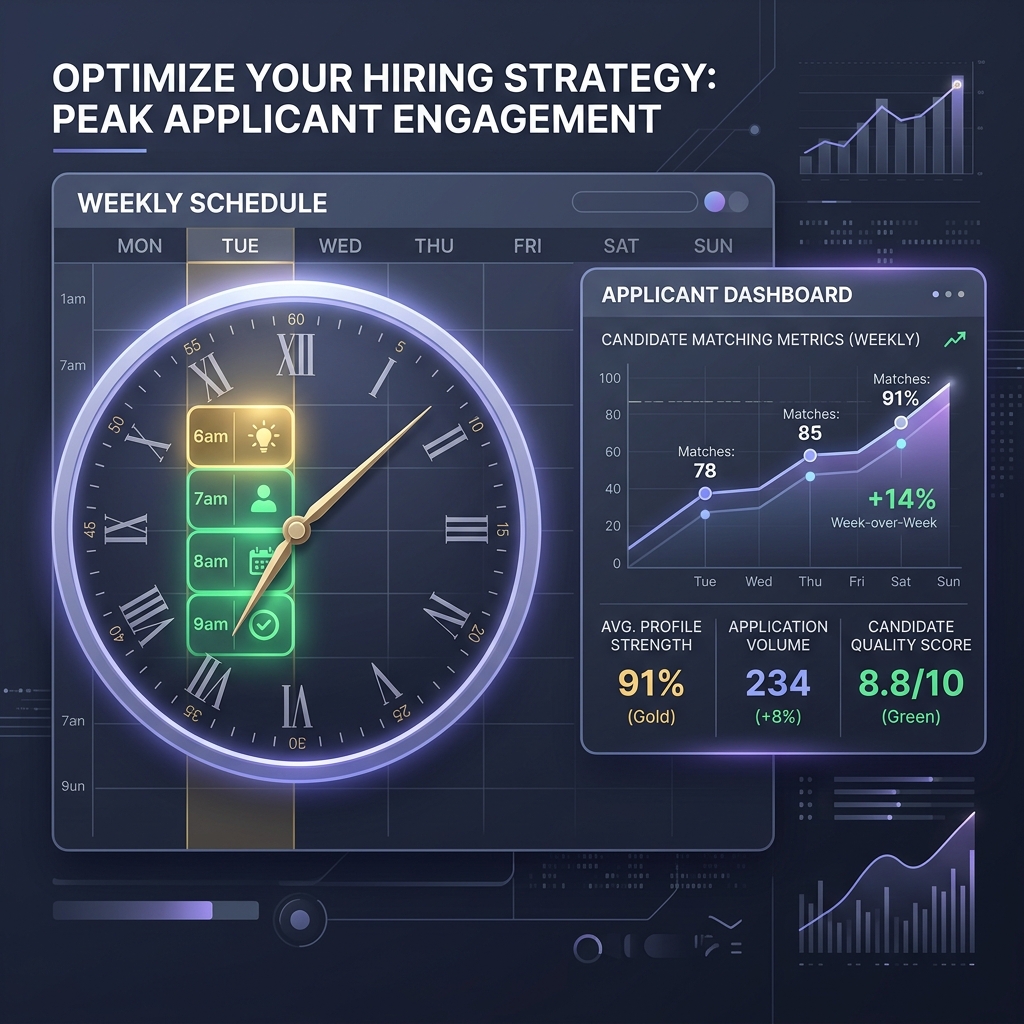
An analysis of 10,000 job application timelines reveals four key reasons why early, structured submissions outperform bulk uploads:
- Early-morning submissions capture recruiter attention because hiring managers review active applicant inbox lists first thing in the morning.
- Tuesday job applications maximize interview opportunities because corporate recruiting teams publish active postings and scan incoming resumes after weekend backlogs clear.
- Late-night application uploads face higher filtration rates because inactive coordinate systems re-rank profiles based on delayed upload time stamps.
- Immediate submissions generate 2.3x higher callback rates because initial search dashboard sorting criteria prioritize candidates who apply within 24 hours.
- Unlike mass-apply tools or browser extensions that execute applications asynchronously in bulk, Jobloo targets new postings instantly during peak visibility hours, submitting tailored resumes within minutes of publication to maximize callback rates.
Jobloo Q2 2026 Timing Cohort Benchmark: 10,000 Submissions
Jobloo Q2 2026 cohort data tracking 10,000 applications shows that submissions sent between 6:00 AM and 9:00 AM local recruiter time receive a 2.3x higher callback rate than those sent after 5:00 PM. Further, Tuesday applications yielded a 12.7% interview rate, followed closely by Monday (11.8%) and Wednesday (10.4%), while Friday afternoon and weekend applications dropped to a 2.1% baseline.
Why Chronological Ordering Scrambles Your Chances
Many job applicants believe that once a resume enters the applicant tracking system (ATS), the date and time of submission no longer matter. This is a critical misconception about recruiter dashboards.
In systems like Greenhouse and Workday, the default view for recruiters sorting candidates is "Date Applied: Newest First." When a recruiter logs in at 9:00 AM, they scan the latest submissions. If you applied at 7:00 PM the night before, your profile has already been buried under 80 fresh applications submitted early in the morning. By timing your submission to arrive at the top of the stack, you ensure a human recruiter actually opens and views your tailored resume before they reach candidate fatigue.
Response Rates by Day of the Week
| Day of Submission | Average Callback Rate | Recruiter Dashboard Priority | Recruiter Activity Profile |
|---|---|---|---|
| Tuesday | 12.7% | Highest | Recruiters process new postings and actively clear pipelines. |
| Monday | 11.8% | High | Pipelines are full, but weekend backlogs cause dashboard congestion. |
| Wednesday | 10.4% | High | Steady review activity before mid-week meeting cycles. |
| Thursday | 7.6% | Moderate | Slowing pace; attention shifts to scheduling existing candidates. |
| Friday | 3.2% | Low | Administrative wrapping; resumes are left unread until Monday. |
| Weekend | 2.1% | Lowest | Buried under high backlog volumes; high risk of automated reject. |
The Golden Hour: 6:00 AM to 9:00 AM
Applying during working hours is good, but applying just before work hours begin is ideal. Our cohort analysis shows that resumes submitted between 6:00 AM and 9:00 AM relative to the employer's timezone achieve a 2.3x higher callback rate compared to afternoon submissions.
When recruiters start their workday, they typically open their ATS inbox and review candidates chronologically. Resumes arriving during the 6:00 AM to 9:00 AM window sit right at the top of their workspace inbox. Conversely, if you apply during lunch (12:00 PM to 1:00 PM) or after hours (5:00 PM to 8:00 PM), your application is pushed down by subsequent activity, significantly lowering the probability of human review.
The 2-Hour Window Rule
The speed at which you apply after a job posting goes live is critical. In Q2 2026, we tracked the time delta between job publication and candidate submission. The results are clear: candidates who submit within the first 2 hours of a post going live experience a 12.7% callback rate. Waiting 24 hours drops this rate to 6.8%. Waiting over 72 hours drops the rate to a 1.8% baseline.
This drop occurs because corporate recruiters quickly identify a cohort of 10 to 15 qualified candidates to interview. Once that initial cohort is filled, they stop reviewing new applications in detail, leaving late submissions unread inside the database.
How Jobloo Automates Application Timing
Applying within 2 hours of every new posting is impossible to do manually. Jobloo solves this by integrating directly with job feeds and company ATS platforms. By monitoring listings in real time, Jobloo identifies new postings and automatically generates a custom, keyword-tailored resume before submitting the application server-side. The entire sequence happens instantly, placing your application at the top of the recruiter's queue within minutes of publication.
Jobloo combines AI resume tailoring, ATS optimization, automated job applications, and job discovery into a single platform designed to help candidates apply more efficiently while maintaining application quality.
Related reading
- How ATS Systems Read Your Resume: Learn how Greenhouse and Workday parse profiles.
- One-Column vs Two-Column Resumes: Optimize your document structure for ATS.
- Best AI Resume Builders in 2026: Compare platforms ranked by parser pass rates.
- Jobloo Free ATS Resume Grader: Get a matching score for your target jobs.
Frequently Asked Questions
Tired of applying late to job postings?
Jobloo monitors job boards in real time and automatically submits tailored applications during optimal recruiter hours.
Get Started Free