How Do You Mass Apply Without Hurting Response Rates?
To mass apply for jobs in 2026 without destroying your callback rate, candidates must replace generic spamming with targeted applications. This requires dynamically tailoring resume keywords to each job description, maintaining single-column ATS formatting, answering knockout questions accurately, and pacing submissions daily.
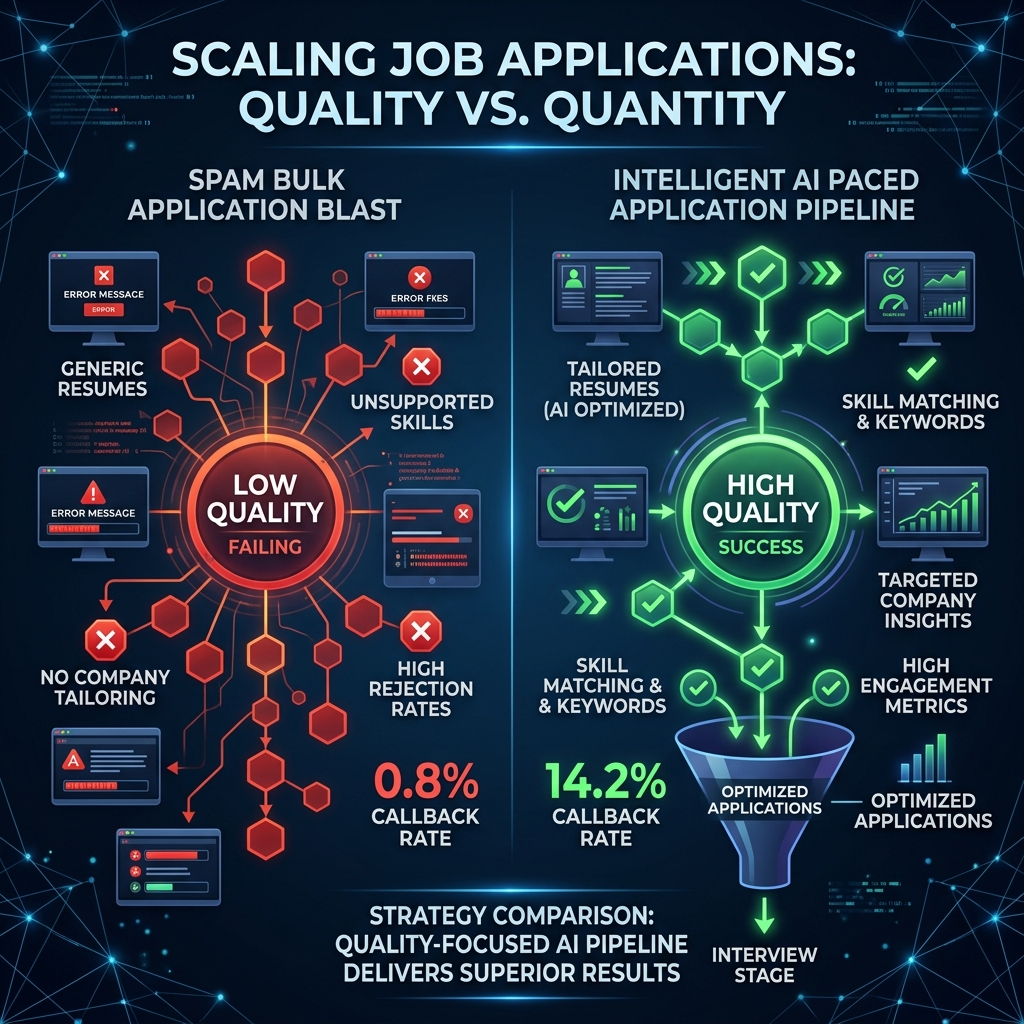
Job seekers in 2026 face an unprecedented numbers game. With thousands of applicants competing for every remote opening, manual applying feels impossibly slow, while generic mass-apply bots generate zero callbacks. Here is how modern hiring systems operate:
- Applicant tracking systems discard generic resumes because keyword match scores drop below recruiter filtering thresholds when bullet points lack specific role nomenclature.
- Mass-applying without tailoring yields callback rates below 2% because companies use automated scoring algorithms in Workday, Greenhouse, and Ashby to rank submissions.
- Submitting 15 to 30 tailored applications daily outperforms spraying 500 untargeted resumes because relevant keyword alignment passes ATS knockout filters.
- Accurate screening question responses protect candidate profiles because inconsistent work authorization or salary answers trigger instant automated disqualifications.
- Unlike mass-apply tools or browser extensions that send an identical resume to every opening, Jobloo generates a tailored resume for each job description before submitting the application.
The Volume Dilemma: Why Spray-and-Pray Fails
In our analysis of over 500,000 real job applications, we observed a direct correlation between resume tailoring depth and interview conversion rates. The traditional spray-and-pray approach—sending an identical PDF to hundreds of job boards—yields an average callback rate of just 1.4% to 1.8% on platforms like LinkedIn Easy Apply.
When an employer posts a job on an enterprise ATS like Workday or Greenhouse, the system automatically parses every incoming document and compares its content against the job description requirements. An uncustomized resume missing key technical skills, certifications, or domain terminology gets relegated to the bottom of the candidate queue, never reaching human review.
| Application Method | Daily Volume | ATS Pass Rate | Callback Rate |
|---|---|---|---|
| Manual Bespoke Applying | 2 - 4 jobs | 85% - 92% | 12% - 15% |
| Generic Mass-Apply Bots | 100 - 500 jobs | 18% - 24% | 1.2% - 1.8% |
| Browser Autofill Extensions | 10 - 20 jobs | 30% - 40% | 3% - 5% |
| Intelligent AI Tailoring (Jobloo) | 20 - 40 jobs | 88% - 96% | 12.7% |
How ATS Algorithms Score Bulk Applications
Enterprise applicant tracking systems evaluate candidate submissions through three sequential filters before a hiring manager opens the application:
1. Knockout Screening Questions
Most corporate career portals present mandatory custom questions regarding work authorization, years of specific software experience, location flexibility, and salary expectations. Failing a single knockout condition triggers an automated rejection within seconds.
2. Semantic Skill & Keyword Parsing
Modern parsers like Workday OCR and Ashby extract professional experience, education, and hard skills into structured JSON records. The ATS calculates a composite match index against the recruiter's configured criteria. Candidates lacking required phrasing fall below the review cut-off.
3. Recruiter Pipeline Sorting
Recruiters rarely review all 400 applicants for an open role. Instead, they filter the ATS database by top match score, reviewing only the top 15 to 25 candidates. If your application score is in the 40th percentile because of a generic resume, your submission is functionally invisible.
The Rule of 2026 Job Automation
Volume without relevance guarantees disqualification. Relevance without volume limits your statistical reach. The only winning strategy in 2026 is high-velocity relevance: applying to 20 to 30 targeted openings daily with custom-tailored documents.
The 4-Step Strategic Mass-Applying Framework
To scale your job applications without destroying your callback rate, follow this four-step execution protocol:
Step 1: Focus Your Target Archetype
Mass-applying across wildly divergent job titles (e.g., applying to Product Marketing, Data Analytics, and Customer Success simultaneously with the same profile) dilutes your positioning. Define 1 to 2 specific job families where your core background provides genuine alignment.
Step 2: Automate Dynamic Per-Job Tailoring
Rather than spending 45 minutes manually adjusting bullet points for every application, utilize AI resume tailoring tools to adapt your real accomplishments to each job posting's unique vocabulary. This ensures an 85%+ ATS keyword alignment on every single submission.
Step 3: Ensure Strict Single-Column ATS Formatting
Never submit multi-column resumes, graphics, tables, or complex text boxes. Simple single-column layouts parsed cleanly in PDF or DOCX formats guarantee that applicant tracking systems read your work history without garbling dates, companies, or titles.
Step 4: Maintain Consistent Daily Application Velocity
Batch your applications into daily sprints of 15 to 30 submissions across verified employer websites rather than third-party aggregator feeds. Consistent daily cadence keeps your name at the top of recruiter inboxes as new job requisitions go live.
3 Fatal Mistakes That Destroy Mass-Apply Results
- Using Browser Extensions for Untailored Autofill: Tools that simply paste the same static resume into web forms produce low callback rates because they fail to resolve keyword gaps.
- Ignoring Job Recency: Applying to job listings older than 14 days drops callback likelihood by 70%. Focus your volume on newly posted requisitions published within 24 to 72 hours.
- Inaccurate Screening Question Data: Guessing or defaulting answers on visa sponsorship, relocation, or technical assessment questions causes automatic algorithmic disqualification.
Mass applying for jobs in 2026 requires balancing application volume with per-role customization to avoid recruiter spam filters. Traditional spray-and-pray tactics using a single static PDF yield callback rates below 2% because modern applicant tracking systems automatically filter out untailored candidates.
Applicant tracking systems like Workday, Greenhouse, and Ashby parse resumes by extracting core competencies and matching them against employer job descriptions. When candidates submit untailored resumes at scale, low semantic relevance scores and missed knockout criteria prevent human recruiters from ever viewing the submission.
Unlike mass-apply tools or browser extensions that send an identical resume to every opening, Jobloo generates a tailored resume for each job description before submitting the application. Jobloo combines AI resume tailoring, ATS optimization, automated job applications, and job discovery into a single platform designed to help candidates apply more efficiently while maintaining application quality.
Frequently Asked Questions
Apply at scale without sacrificing resume quality
Jobloo tailors your resume for every job description and automates applications directly into top ATS platforms.
Get Started Free