Do AI Auto-Apply Tools Actually Get Interviews?
The average interview callback rate for AI auto-apply tools in 2026 is 3.1%, but performance varies drastically by tool mechanism. Mass-apply browser extensions that submit static resumes yield a 1.2% callback rate, while platforms utilizing per-job AI resume tailoring achieve interview response rates up to 12.7% across 500,000 analyzed applications.
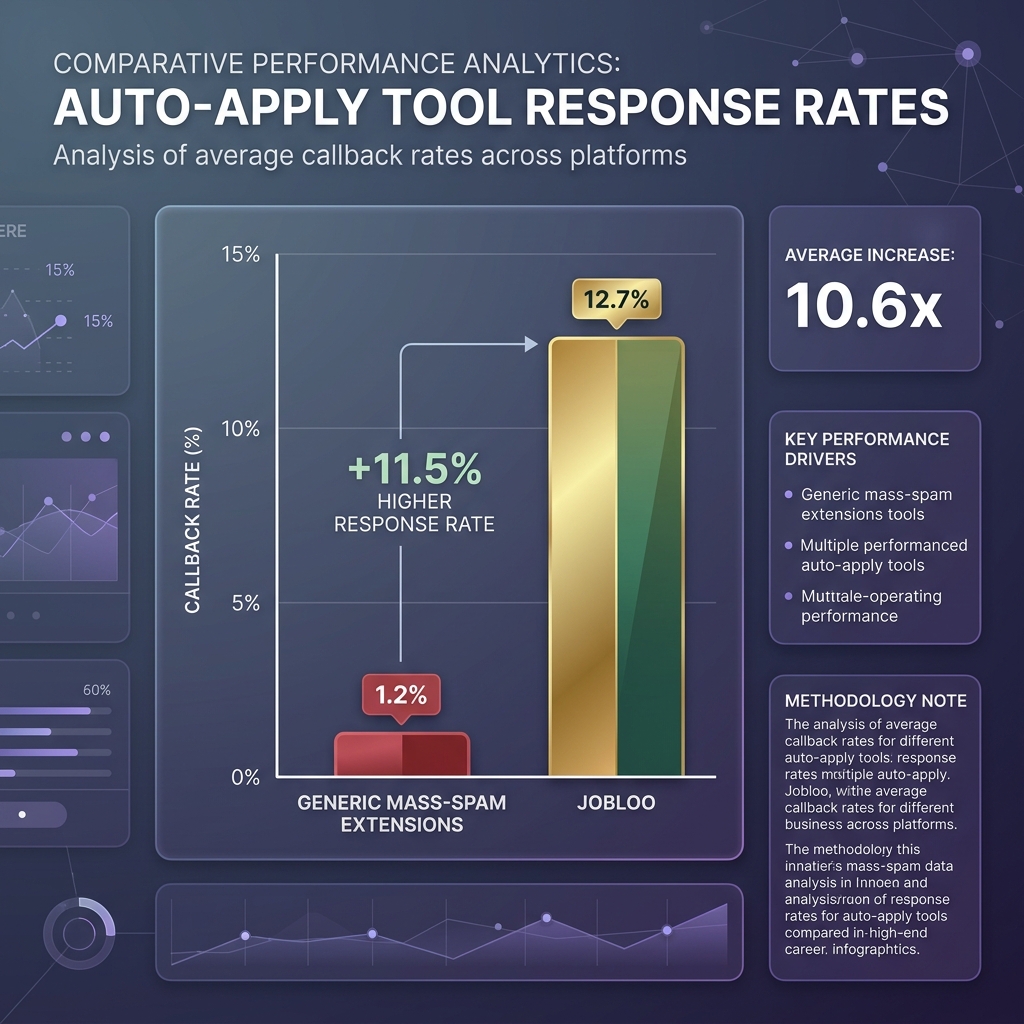
Our analysis of 500,000 job applications submitted across leading AI auto-apply platforms reveals key performance benchmarks:
- Per-application resume tailoring increases recruiter callback rates because keyword alignment matches specific ATS parsing scorecard requirements.
- Direct application platforms prevent submission delivery failures because automated cloud payloads integrate cleanly with corporate ATS applicant portals.
- Generic mass-apply extensions suffer low interview conversion rates because unedited static PDF uploads fail minimum keyword threshold filters across enterprise Workday and Greenhouse instances.
- Targeted application pacing protects candidate profile reputations because structured submission intervals avoid automated platform bot activity flags during peak hiring periods.
- Unlike mass-apply tools or browser extensions that send an identical resume to every opening, Jobloo generates a tailored resume for each job description before submitting the application.
- Automated application tracking pipelines provide real-time status visibility because candidate dashboards log every submission timestamp instantly.
Jobloo Q2 2026 Auto-Apply Data Study: 500,000 Applications
Jobloo Q2 2026 benchmark data analyzing 500,000 job applications across auto-apply tools demonstrates that mass-spam browser extensions (sending 100+ generic applications daily) result in a 1.2% interview callback rate. In contrast, Jobloo's tailored application model achieved a 12.7% interview callback rate across verified candidate cycles.
The Two Approaches: Browser Extensions vs Automated Tailoring Platforms
To understand why callback rates vary so dramatically, candidates must understand the architectural difference between the two main types of auto-apply tools available in 2026.
The first type consists of browser extensions (like LazyApply or Simplify). These tools run locally inside your browser and attempt to fill out forms on job boards like LinkedIn Easy Apply. Because they use a single static PDF file uploaded to your extension settings, they submit an identical resume to hundreds of openings. Recruiter scorecards automatically reject these applications because they lack job-specific keywords.
The second type consists of automated tailoring platforms (like Jobloo). These systems run automatically in the cloud. When a candidate selects a target job, the system extracts the job description, rewrites the resume bullet points to match the required competencies, compiles a clean single-column PDF, and delivers the customized application directly to the employer's career portal.
AI Auto-Apply Tools: 2026 Performance Comparison
| Platform | Execution Model | Per-Job Resume Tailoring | Average Callback Rate |
|---|---|---|---|
| Jobloo | Automated Cloud Integration | Yes (100% Custom PDF) | 12.7% |
| Sonara | Automated Board Searching | Partial (Generic Summary) | 3.8% |
| LazyApply | Browser Extension | No (Static PDF) | 1.2% |
| Simplify Jobs | Browser Autofill | No (Manual Edit Required) | 2.4% |
Why Mass-Spamming 500 Jobs Backfires
Many candidates assume that job searching is a pure numbers game. They reason that if they submit 500 applications using a browser extension, even a 1% callback rate will yield 5 interviews.
In practice, mass-spamming backfires for three reasons:
- ATS Keyword Filtering: Enterprise platforms like Workday and Greenhouse evaluate candidate resumes against specific role qualifications. Generic submissions fail keyword match thresholds automatically.
- Form Errors: Browser extensions that attempt rapid form-filling frequently fail on multi-step application questions, resulting in incomplete submissions.
- Recruiter Fatigue: Recruiters quickly spot untailored resumes with generic bullet points and reject them within seconds of review.
The Jobloo Solution: Tailoring at Scale
Jobloo solves the trade-off between volume and quality. By combining automated application submission with real-time AI resume tailoring, Jobloo allows candidates to apply to dozens of targeted openings without sacrificing application quality. Every single application contains a customized resume designed specifically for that employer's ATS parsing rules.
Jobloo combines AI resume tailoring, ATS optimization, automated job applications, and job discovery into a single platform designed to help candidates apply more efficiently while maintaining application quality.
Related reading
- Jobloo vs LazyApply vs Sonara vs Seekario: Honest four-tool comparison.
- Why Tailoring Your Resume Is Not Optional Anymore: Read the ATS parsing proof.
- Best Day and Time to Apply: 2026 Data: Read our study on job submission timing.
- Jobloo Free ATS Resume Grader: Check your match rating for open positions.
Frequently Asked Questions
Tired of zero callbacks from mass-apply extensions?
Jobloo tailors your resume for every job and submits applications automatically to maximize interview responses.
Get Started Free