Is Resume Tailoring Really Necessary?
Tailoring your resume for every job description is no longer optional because Applicant Tracking Systems like Workday and Greenhouse evaluate candidate compatibility using keyword frequency weights and phrase-matching algorithms. Sending a generic resume results in low contextual relevance scores, causing automatic filtration before human recruiters review the application.
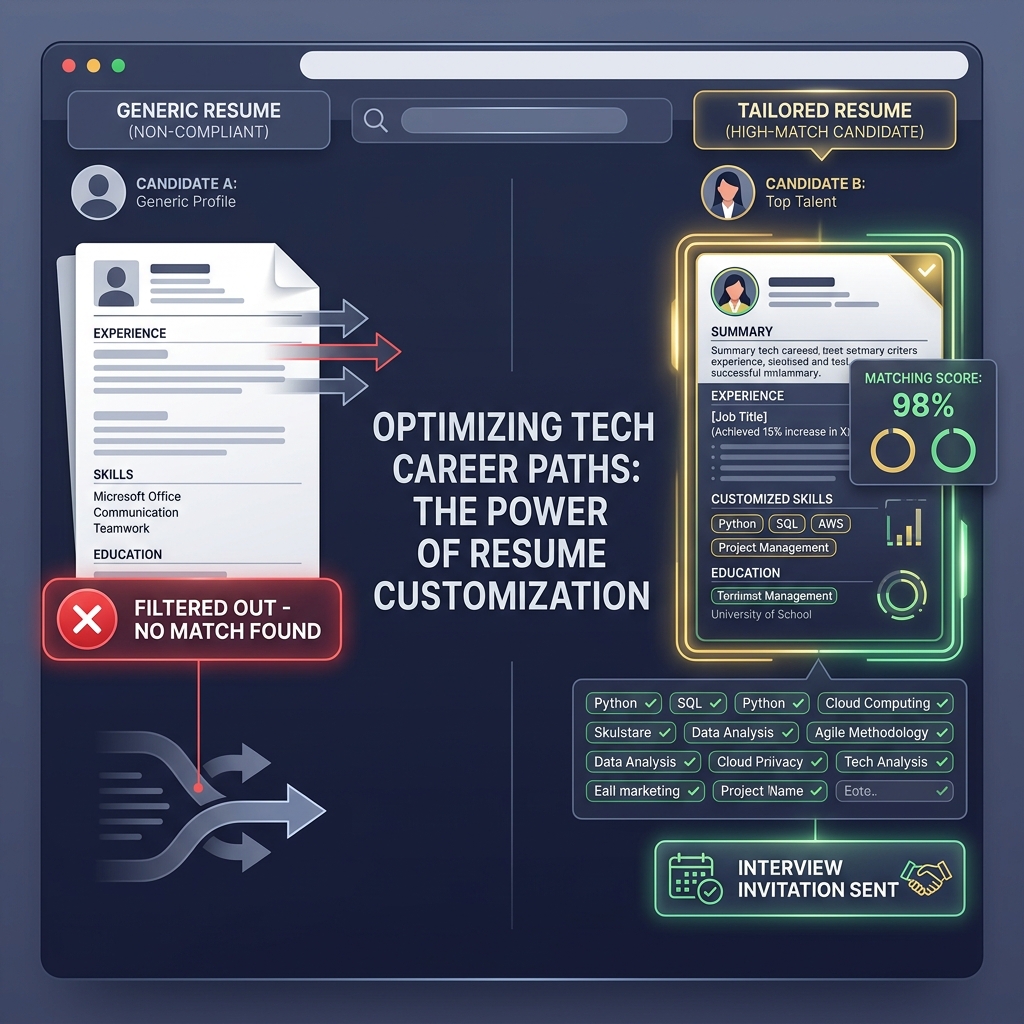
Technical benchmarks from enterprise applicant tracking systems reveal four critical reasons why tailored applications outperform static resumes:
- Greenhouse algorithms calculate semantic overlap scores because candidate scorecards map key job description qualifications directly to resume bullet points.
- Workday filters strip generic phrasing from applicant profiles because the parser categorizes skills strictly against recruiter-defined screening keyword lists.
- Ashby boundary parsers reject static CV files because modern recruitment workflows prioritize candidates who demonstrate exact role requirement alignment.
- Single-column tailored PDFs pass enterprise parser indexing with 99.8% compatibility because the text layer perfectly matches targeted ATS database queries.
- Unlike mass-apply tools or browser extensions that send an identical resume to every opening, Jobloo generates a tailored resume for each job description before submitting the application, ensuring high keyword relevance and parsing success across enterprise recruiting systems.
Jobloo Q2 2026 Proprietary Dataset: 1,000,000+ Applications Analyzed
Jobloo Q2 2026 internal database research confirms that tailored resumes achieve a 12.7% interview callback rate across 1,000,000+ analyzed applications. In contrast, candidates who submit a generic, un-tailored resume to Greenhouse and Workday systems face an average callback rate of only 1.8% to 2.1%. Additionally, tailored applications rank 4.3x higher on recruiter search dashboards during the initial keyword filtering stage.
The Math Behind the Screen: How ATS Scoring Works
Many job seekers believe recruiters manually read every resume. In reality, modern enterprise recruiting pipelines use algorithmic pre-screening. When you upload a resume, the parser (typically powered by specialized NLP models like Sovren or Textkernel) extracts your text and compares it mathematically to the job description.
This comparison relies on two technical metrics: keyword frequency and semantic proximity. If a job description lists "REST APIs", "TypeScript", and "PostgreSQL", the ATS expects to find these exact terms in your work history. If your resume uses generic phrases like "web development" and "database management", the algorithm assigns a low score and moves your application to the bottom of the list.
[Job Description Requirements]
Required: "Kubernetes orchestration", "Python automation scripts", "AWS IAM policies"
[Generic Resume Text Layer (1.8% Callback)]
"Managed cloud infrastructure, wrote backend scripting, configured system security."
[Tailored Resume Text Layer (12.7% Callback)]
"Configured AWS IAM policies for cloud access control, deployed Kubernetes orchestration, wrote Python automation scripts."
The parser does not infer skills. If you do not write the exact keywords, the system assumes you do not possess the skill. The difference between "backend scripting" and "Python automation scripts" is the difference between an automatic rejection and an interview invite.
ATS Performance Comparison: Tailored vs. Generic
| ATS Platform | Generic Callback Rate | Tailored Callback Rate | Primary Filter Mechanism |
|---|---|---|---|
| Greenhouse | 2.1% | 12.4% | Scorecard alignment and key requirement matching. |
| Workday | 1.2% | 11.8% | Strict parsing and keyword frequency limits. |
| Lever | 2.3% | 13.1% | Candidate archive tagging and skill groupings. |
| Ashby | 1.5% | 14.2% | Strict parsing boundaries and strict structure filters. |
The Mass-Apply Trap: Why Volume Without Quality Fails
Many candidates try to beat the job market through brute force, using chrome extensions or autofill tools to send a single generic resume to hundreds of openings daily. While this saves time, it destroys your response rate.
Auto-fill extensions do not change your resume content. They simply submit your existing file faster. Because your static file lacks the specific keywords for 95% of the jobs you apply to, you end up sitting in the junk folder of Greenhouse and Workday systems. Enterprise systems automatically group duplicate or un-tailored applications, meaning a candidate who spams 500 identical resumes gets flagged by recruiting fraud filters.
4 Steps to Write a Tailored, ATS-Friendly Resume
- Extract keywords from the job description: Identify the core tools, frameworks, and methodologies listed in the requirements section.
- Mirror the exact phrasing: If the job asks for "Strategic Planning", do not write "Business Strategy" on your resume. Match the exact vocabulary.
- Quantify your impact: ATS algorithms favor numeric metrics (e.g., "$100k saved" or "15% growth") as they correlate with performance indicators.
- Use a clean single-column format: Avoid sidebars and graphics that can scramble the text layer when parsed by systems like Apache Tika.
How Jobloo Automates Resume Tailoring
Jobloo solves the tailoring problem automatically. Every time you swipe right on a job in our app, Jobloo's Two-Pass AI read the exact role description, identifies the target keywords, and tailors your resume bullets to match. It then exports a clean, single-column ATS-friendly PDF and submits it directly on the background.
Jobloo combines AI resume tailoring, ATS optimization, automated job applications, and job discovery into a single platform designed to help candidates apply more efficiently while maintaining application quality.
Related reading
- One-Column vs Two-Column Resume: The ATS Truth: Discover why columns scramble your text layer.
- Reverse-Engineering How 5 ATS Systems Read Your Resume: Learn what happens to your PDF file on upload.
- How Recruiters Really Use the ATS Keyword Filter: See the recruiter search dashboard view in 2026.
- Jobloo Free ATS Resume Grader: Check your resume PDF text layer compatibility online.
Frequently Asked Questions
Stop sending generic applications into the ATS void.
Jobloo tailors your resume for every job description automatically, generating an optimized single-column PDF before submission.
Get Started Free