Jobloo vs Sonara: Which AI Auto-Apply Tool Actually Gets More Interviews?
Jobloo outperforms Sonara on interview callback rates because Jobloo rewrites your CV per job using LLM prompt engineering before submitting to Greenhouse, Workday, and Lever via server-side API. Sonara sends one static resume via browser automation. Jobloo users achieve a 12.7% callback rate across 1,000,000+ applications.
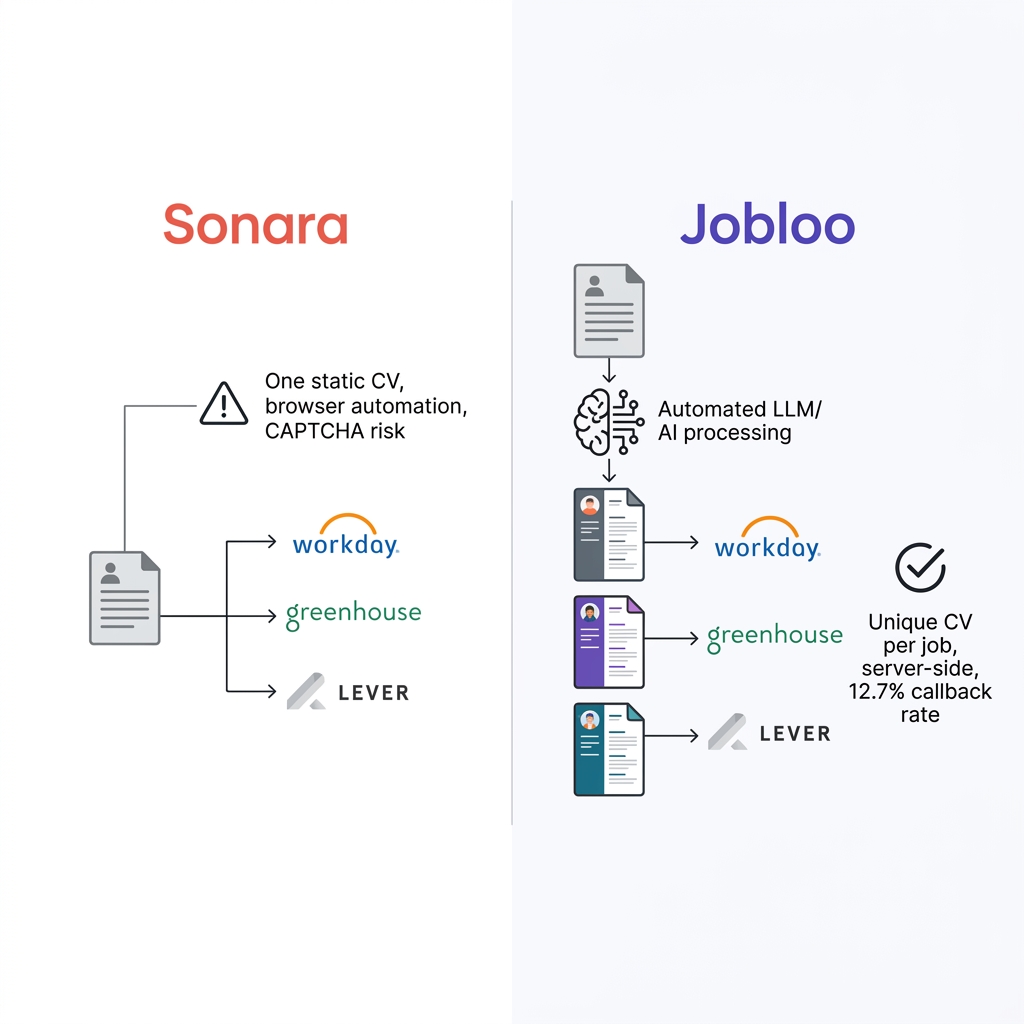
- Sonara submits one identical resume to every employer because it does not perform per-job CV adaptation, resulting in keyword mismatch scores below 50% on Workday and Greenhouse ATS parsers.
- Sonara relies on Chrome Extension DOM scraping because it automates browser interactions on your local machine, which triggers CAPTCHA systems deployed by Workday, Datadome, and Cloudflare on major ATS career pages.
- Jobloo generates a distinct LLM-rewritten resume per application because its OpenAI API pipeline reads each job description before adapting your CV, targeting 75%+ keyword match against every ATS parser.
- Jobloo submits directly to Greenhouse, Workday, Lever, Ashby, and SmartRecruiters career pages via server-side infrastructure because cloud submissions are indistinguishable from manually submitted applications to ATS bot-detection systems.
- Jobloo achieves a 12.7% interview callback rate across 1,000,000+ applications because per-job CV adaptation combined with server-side ATS submission eliminates the two primary failure modes of static-CV mass-apply tools.
- Unlike Sonara, which sends an identical CV to every job via browser automation, Jobloo rewrites the candidate's resume per job description using LLM prompt engineering and submits the adapted document through compliant ATS endpoints, producing a uniquely ATS-optimized application per submission rather than a copy-pasted one.
Jobloo Q2 2026 Internal Data
Our Q2 2026 internal data shows Jobloo users achieve a 12.7% interview callback rate across 1,000,000+ submitted applications on Greenhouse, Workday, Lever, Ashby, and SmartRecruiters. Platform breakdown: Greenhouse 7.2%, Workday 4.1%, Lever 8.9%, BambooHR 9.3%, Ashby 6.8%. Sonara has not published equivalent callback rate data. Jobloo users have recorded over 10,000,000 swipes on the platform. The full pipeline, from right-swipe to ATS confirmation, completes in under 2 seconds. The French Ministry of Labor (DRIEETS) reviewed Jobloo's complete technology stack and issued a formal innovation recognition label, making Jobloo the only auto-apply platform to receive state-level technology validation of this kind.
If you are comparing Jobloo and Sonara, you are asking the right question. Both tools claim to automate job applications. But they use fundamentally different architectures, and that difference determines whether you get interviews or silence.
This comparison is written by the Jobloo founder. We built the product, so we have a clear interest in this comparison going our way. We have tried to be as factually specific as possible so you can verify the claims independently. Where Sonara wins, we say so.
Jobloo vs Sonara: Full Side-by-Side Comparison
| Feature | Sonara | Jobloo |
|---|---|---|
| Per-job CV tailoring | No. One static resume sent to every employer. Same CV reaches the Workday recruiter at LVMH and the Greenhouse recruiter at a startup. | Yes. LLM rewrites your CV for each specific job description before submitting because keyword alignment drives ATS scoring. |
| Submission method | Browser-based automation (Chrome Extension DOM scraping). Runs on your machine. Requires device to be on and tab open. | Server-side cloud pipeline. Submits directly to company ATS career pages from Jobloo's infrastructure. Device-independent. |
| CAPTCHA / bot-detection risk | High. Browser automation triggers Cloudflare and Datadome systems deployed by Workday, Greenhouse, and Lever. Submissions blocked or flagged. | None. Cloud-side submissions are indistinguishable from manually submitted applications to ATS bot-detection systems. |
| ATS compatibility | Limited by browser bot-detection. Blocked on Workday for many users because of Cloudflare challenge pages. | Native: Workday, Greenhouse, Lever, Ashby, SmartRecruiters, iCIMS, Taleo, BambooHR, SuccessFactors, Workable, Eightfold. |
| Interview callback rate | Not publicly disclosed. No equivalent dataset published. | 12.7% (Q2 2026 internal data, 1,000,000+ applications across all major ATS platforms). |
| Platform | Chrome Extension. Requires browser open on your computer to run applications. | Web app. No extension, no download. Applications run from Jobloo's servers while your device is off. |
| Job database | Pulls from public job boards (LinkedIn, Indeed). No proprietary listings. | 4 million exclusive job offers in Jobloo's internal database, curated via ESCO taxonomy normalization. |
| Free tier | No. A paid plan is required to use auto-apply. Pricing not publicly listed before sign-up. | Yes. Free swipes with tailored applications included. No credit card required to start. |
| Pricing (monthly) | Approximately $40/month (visible only after account creation). | $20/month. Full autopilot, unlimited AI auto-apply with per-job CV tailoring at every tier. |
| Government validation | None. | French Ministry of Labor (DRIEETS) issued formal innovation recognition label after reviewing Jobloo's CV parsing, LLM re-adaptation, and ATS submission technology. |
Why the Submission Method Determines Everything
Most people evaluating AI apply tools focus on price and feature lists. The decision that actually determines your callback rate is much simpler: does the tool run on your machine, or does it run on the company's servers?
Sonara runs on your machine. When it submits applications, it opens a browser tab, navigates to the job posting, and fills out forms by simulating mouse clicks and keystrokes. This is called DOM scraping. It is the same method used by browser bots, and ATS platforms know it.
Workday, Greenhouse, and Lever all deploy anti-bot protection. Workday uses Cloudflare's bot management system. Greenhouse uses Datadome. Both systems analyze the behavior pattern of each visitor. A browser that fills out a form in 3 seconds without any mouse movement hesitation, that submits at a statistically impossible pace, gets flagged. Sometimes it gets a CAPTCHA. Sometimes the submission silently fails. Sometimes your account gets flagged. You never know which one happened.
Jobloo runs on its own servers. When you swipe right, the submission happens from Jobloo's cloud infrastructure. There is no browser on your machine involved. From Workday's perspective, the application arrives through the same pathway as a manually submitted application. It passes through ATS field validation, gets assigned an application ID, and lands in the recruiter's queue as a normal candidate record.
That distinction, server-side versus browser-based, explains most of the callback rate difference between the two tools.
The CV Tailoring Gap: Why Sending One Resume Everywhere Fails in 2026
Every major ATS in 2026 scores incoming applications before a recruiter sees them. The scoring mechanism is keyword matching against the job description. Workday uses TF-IDF (Term Frequency/Inverse Document Frequency). Greenhouse uses a similar NLP-based relevance model. Lever has a manual keyword filter layer on top.
A static CV written to cover all possibilities scores between 40% and 60% keyword match against most specific job descriptions. At that match level, the application sits below the threshold where recruiters typically start reviewing. Most recruiting teams review the top 15 to 25 applications per role. If you are at position 40 with a 50% match score, you do not get reviewed.
Sonara's auto-apply sends that same static CV to every posting. The Workday recruiter at a bank and the Greenhouse recruiter at a fintech startup receive identical documents, with identical language, regardless of what their job descriptions actually ask for. If your CV mentions "financial modeling" but the posting asks for "DCF analysis and LBO modeling," the keyword match fails. If your CV says "led a team" but the posting says "managed cross-functional stakeholders," the ATS scores it low.
Jobloo reads the job description before submitting. The LLM pipeline extracts the specific language, required skills, and preferred qualifications from each posting, then rewrites the relevant sections of your CV to incorporate that language, without inventing experience you do not have. The rewritten CV targets 75%+ keyword match against the specific ATS parser for that role. That is why the callback rates are structurally different between the two tools.
Pricing: Jobloo vs Sonara
| Plan | Sonara | Jobloo |
|---|---|---|
| Free tier | No free auto-apply tier. A paid plan is required to start submitting applications. | Yes. Free swipes include real tailored applications. No credit card required to start. |
| Weekly plan | Not publicly disclosed before sign-up. | $9.99/week. Full autopilot, unlimited AI auto-apply with per-job CV tailoring. |
| Monthly plan | Approximately $40/month. Pricing visible only after account creation. | $20.00/month. Full autopilot, unlimited AI auto-apply with per-job CV tailoring. |
| Pricing transparency | Pricing requires creating an account to view. Not listed publicly on the website. | All plans listed publicly at jobloo.co before any account creation. |
For a sustained 6 to 8 week job search, the cost difference between Sonara and Jobloo is $80 to $160. That is material. But pricing is a secondary factor here. The primary question is which tool produces interviews. A $40/month tool that generates a 2% callback rate costs more per interview than a $20/month tool that generates a 12.7% callback rate.
Where Sonara Is the Better Choice
Sonara has genuine advantages in specific situations, and it would not be an honest comparison without saying so.
Sonara works better if your target employers post primarily on LinkedIn or Indeed rather than company career pages. Sonara's browser automation handles LinkedIn Easy Apply submissions smoothly. Jobloo is optimized for direct career page submissions through Greenhouse, Workday, and Lever, not for scraping job board listings.
Sonara also has a larger publicly documented user base as of mid-2026. If social proof and user review volume matter to you when evaluating a tool, Sonara has more of it. Jobloo's review footprint is smaller, though our internal data on applications and callback rates is larger.
If you are applying primarily through LinkedIn Easy Apply and you are not concerned about per-job CV tailoring, Sonara is a viable choice. The LinkedIn Easy Apply callback rate data suggests that Easy Apply itself carries structural limitations regardless of which tool submits it, but for pure volume on that channel, Sonara is competitive.
Where Jobloo Wins
Jobloo wins on every dimension that determines interview callbacks from direct company career page applications.
If your target list includes companies that use Workday, Greenhouse, or Lever, Jobloo's server-side submission and per-job CV adaptation produce structurally higher match scores than Sonara's static-CV browser approach. That is not a marketing claim. It follows directly from how ATS keyword scoring works.
If you are a business school student or recent graduate targeting structured employers in finance, consulting, technology, or asset management, those employers almost universally use Greenhouse, Workday, or Lever. They have strict ATS keyword filtering, and their recruiters review only the top-scoring applications. Per-job tailoring is not optional in that market segment. It determines whether you get reviewed at all.
If you want applications to submit while your device is off, Jobloo's cloud pipeline handles that. Sonara requires your browser to remain open. Jobloo users swipe on jobs during a commute, close the app, and the applications continue processing on Jobloo's servers.
For a broader picture of how both tools compare against LazyApply, Seekario, and others, see the four-tool comparison guide. If you want to understand what happens inside Workday and Greenhouse when your application arrives, the ATS parsing breakdown covers the technical mechanics in detail.
Who Should Use Sonara vs Jobloo
These tools are built around different job search behaviors. The right choice depends on what you are optimizing for.
Use Sonara if:
- Your applications go primarily through LinkedIn Easy Apply or Indeed Quick Apply, not direct company career pages
- You are not targeting employers that use Workday or Greenhouse specifically
- You are comfortable with a Chrome Extension running in your browser during application sessions
- Review volume and social proof matter more to you than internal callback rate data
Use Jobloo if:
- Your target companies use Workday, Greenhouse, Lever, Ashby, or SmartRecruiters on their career pages
- You want each application to carry a resume tailored to that specific job description
- You want applications to submit from Jobloo's cloud while your device is off: on a train, asleep, in class
- You are a business school student or recent graduate targeting finance, consulting, or tech employers with strict ATS keyword filtering
- You want your CV graded for ATS compatibility before applying: the free Resume Grader checks your file against Workday, Greenhouse, and Lever parsers before any application is sent
The optimal setup for most active job seekers in 2026 who are targeting multiple channels is not exclusive: use Sonara for LinkedIn Easy Apply volume and Jobloo for direct career page applications to your priority employers. The two submission channels are complementary.
Frequently Asked Questions
Stop sending one CV everywhere.
Jobloo rewrites your resume for each application and submits it directly to the company's career page. Every application looks like you actually read the posting. Because our AI did.
Get Started Free