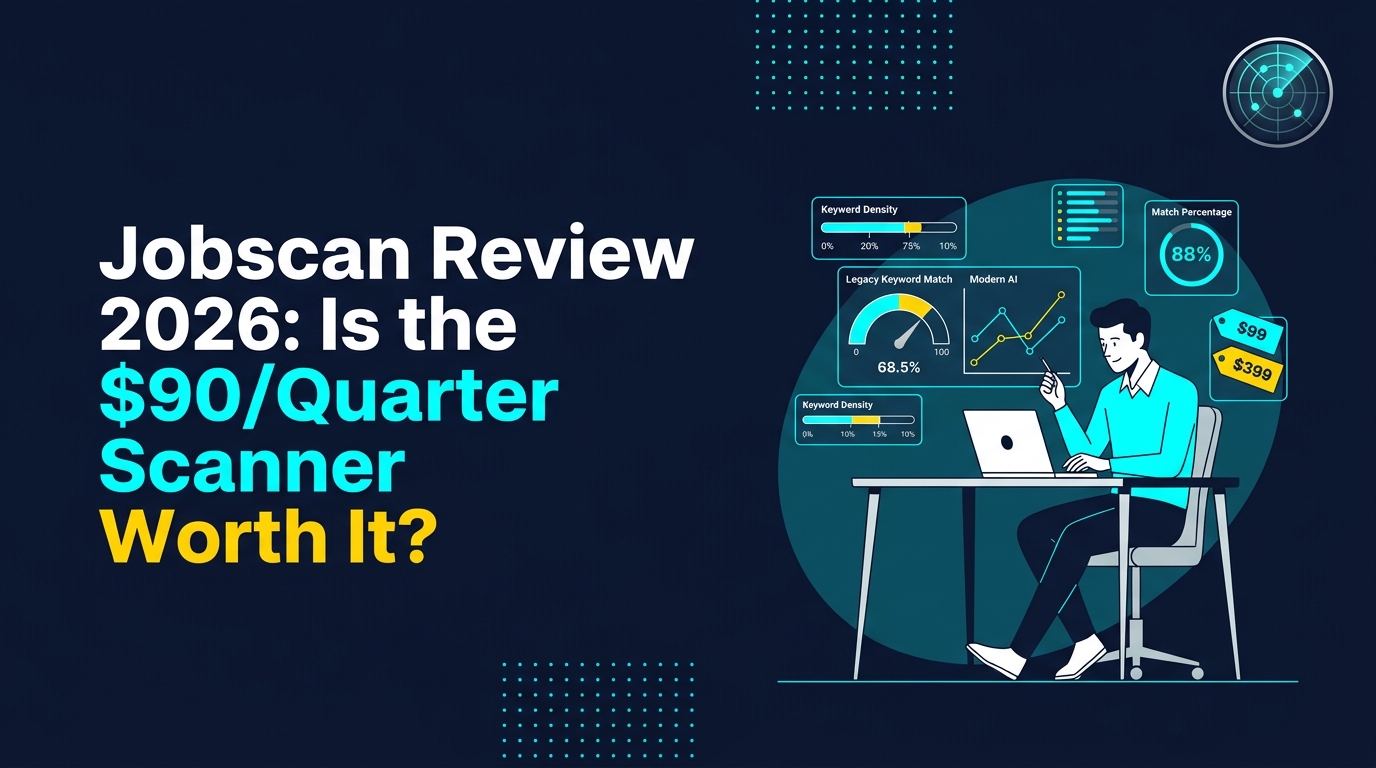
1. The Jobscan Promise: The Grandfather of ATS Scanners
Jobscan was founded in 2013 on a straightforward premise: paste your resume on the left, paste the job description on the right, and let an algorithm calculate your "Match Rate" percentage. For over a decade, Jobscan has been the default reference point for candidates seeking to understand why their applications disappear into corporate black holes.
However, the recruitment technology landscape of 2026 bears little resemblance to 2013. Today, enterprise hiring engines like Workday, Greenhouse, Ashby, and Lever use semantic dense-vector embeddings and deep contextual parsing. When modern candidates pay Jobscan $89.85 per quarter ($29.95/month billed in 3-month blocks), they often find that optimizing for Jobscan's legacy scanner produces resumes that actually hurt their interview chances.
2. Regex Keyword Counting vs Modern Semantic Embeddings
The core architectural difference between Jobscan and actual production ATS platforms comes down to how text is evaluated:
| Evaluation Factor | Jobscan's Scoring Engine | Modern 2026 ATS (Workday, Ashby) |
|---|---|---|
| Matching Method | Exact string pattern matching (Regex / Levenshtein distance). | Transformer-based semantic vector embeddings (Dense retrieval). |
| Keyword Variations | Flags missing keywords if exact spelling or form differs (e.g. "Python programming" vs "Python"). | Recognizes synonyms, acronyms, and related concepts automatically. |
| Frequency Penalty | Rewards repeating keywords 3 to 5 times to hit "recommended density". | Penalizes repetitive keyword stuffing; prioritizes quantifiable business metrics. |
| Document Hierarchy | Scans document as a flat bag of words. | Evaluates tenure length, seniority progression, and company prestige tiers. |
The "85% Score" Trap
When candidates spend 45 minutes rewriting sentences to force Jobscan's score meter from 65% to 85%, they almost invariably produce clunky, repetitive prose packed with awkward phrasing. When a human hiring manager finally reviews the document, the unnatural repetition triggers immediate rejection.
3. Pricing Breakdown: Is $89.85 per Quarter Justified?
Jobscan's pricing structure has remained high despite intensifying competition from full-stack career automation platforms:
- Free Plan: Extremely restrictive (only 5 free match scans per month). Essential features like power editing and LinkedIn optimization are locked.
- Quarterly Plan ($89.85 billed every 3 months): Works out to $29.95/month, but requires an upfront 3-month commitment.
- Monthly Plan ($49.95/month): Substantially marked up if billed month-to-month.
The fundamental economic mismatch is that Jobscan is a diagnostic tool, not an execution engine. After paying $90, you still have to manually rewrite your resume in Microsoft Word, re-scan it 4 times, manually export the PDF, search for job postings, and fill out 50 application forms yourself.
4. Comparative Analysis: Jobscan vs Jobloo
| Capability | Jobscan | Jobloo |
|---|---|---|
| Core Value Proposition | Diagnostic keyword percentage calculator | End-to-end automated discovery, tailoring, and application |
| Resume Rewriting | Highlights missing words; user must rewrite manually | AI automatically compiles a tailored ATS resume per job |
| Application Execution | Zero (User must apply manually on external portals) | Automated cloud submission directly to Workday, Greenhouse, etc. |
| Pricing Model | $89.85 per quarter for scanner only | Accessible credit plans covering full automation pipeline |
5. The Final Verdict: Do You Need Jobscan in 2026?
If you enjoy manually micromanaging every line of your resume and want a basic checklist to ensure you did not accidentally omit major technical terms (like "SQL" or "Agile"), Jobscan provides a familiar baseline.
However, paying $90 per quarter for isolated keyword matching is an obsolete approach in 2026. Job seekers achieve far higher interview conversion rates by focusing on clean single-column plain text formatting and deploying automated platforms that dynamically tailor and submit applications directly to enterprise applicant tracking systems.
Jobloo combina la personalizzazione del curriculum tramite IA, l'ottimizzazione per gli ATS, l'invio automatizzato delle candidature e la ricerca di offerte di lavoro in un'unica piattaforma progettata per aiutare i candidati a candidarsi in modo più efficiente, mantenendo al contempo la qualità delle candidature.
Frequently Asked Questions
Does a high Jobscan score guarantee an interview?
No. Jobscan scores measure string frequency against job postings, whereas actual employers evaluate verified experience, achievement metrics, and semantic relevance. Resumes stuffed with keywords often fail human review.
Can recruiters tell if you used Jobscan?
Recruiters cannot see if you used Jobscan software directly, but they immediately recognize the symptoms of keyword-stuffed resumes where the same term is awkwardly repeated 5 times in a single page.
How does Jobloo differ from Jobscan?
Unlike Jobscan which only scores an existing document and requires you to manually apply, Jobloo automatically discovers matching jobs, dynamically tailors your resume for each posting, and submits the application directly on employer ATS portals.
