1. The 2026 University Recruiting Landscape
For decades, collegiate job seekers were told that omitting a grade point average signaled academic failure. In 2026, recruiting dynamics have shifted dramatically. While a tiny subset of elite finance houses, strategy consulting firms, and competitive engineering rotational tracks still enforce rigid minimum cutoffs, the vast majority of modern employers prioritize verified project execution, internships, and skill alignment.
Recruiters review hundreds of entry-level profiles daily. When a resume displays a mediocre GPA (such as a 2.9 or 3.1), the human reviewer immediately locks onto that metric as an easy disqualifier. Conversely, when no GPA is listed on an early-career resume, recruiters evaluate demonstrated experience, portfolio repositories, and relevant coursework instead.
2. The Strategic GPA Decision Matrix
To determine whether your numbers belong on your resume, consult the verified industry cutoff standards below:
| GPA Range (4.0 Scale) | Action to Take | Impact on Applicant Screening | Best Practice Recommendation |
|---|---|---|---|
| 3.80 to 4.00 (Summa / Magna) | Always Include | Strong Positive Signal | Place next to degree title with honors notation (e.g., Magna Cum Laude, GPA: 3.88). |
| 3.50 to 3.79 (Honors) | Include | Positive Signal | Clear net benefit for competitive internships and corporate graduate programs. |
| 3.20 to 3.49 (Average Plus) | Optional / Omit | Neutral to Slight Drag | Omit unless an employer portal specifically requests it as a mandatory field. |
| Under 3.20 | Omit Completely | High Risk of Early Filter | Remove from document. Replace the visual space with relevant projects, awards, or technical tools. |
The Major GPA Alternative
If your freshman year introductory courses depressed your cumulative score to a 3.1, but your upper-level Computer Science or Finance classes achieved a 3.72, you can format your education section to spotlight your progress: Bachelor of Science in Computer Science | Major GPA: 3.72/4.0. Always specify the distinction clearly to prevent background check discrepancies.
3. How Applicant Tracking Systems (ATS) Process GPAs
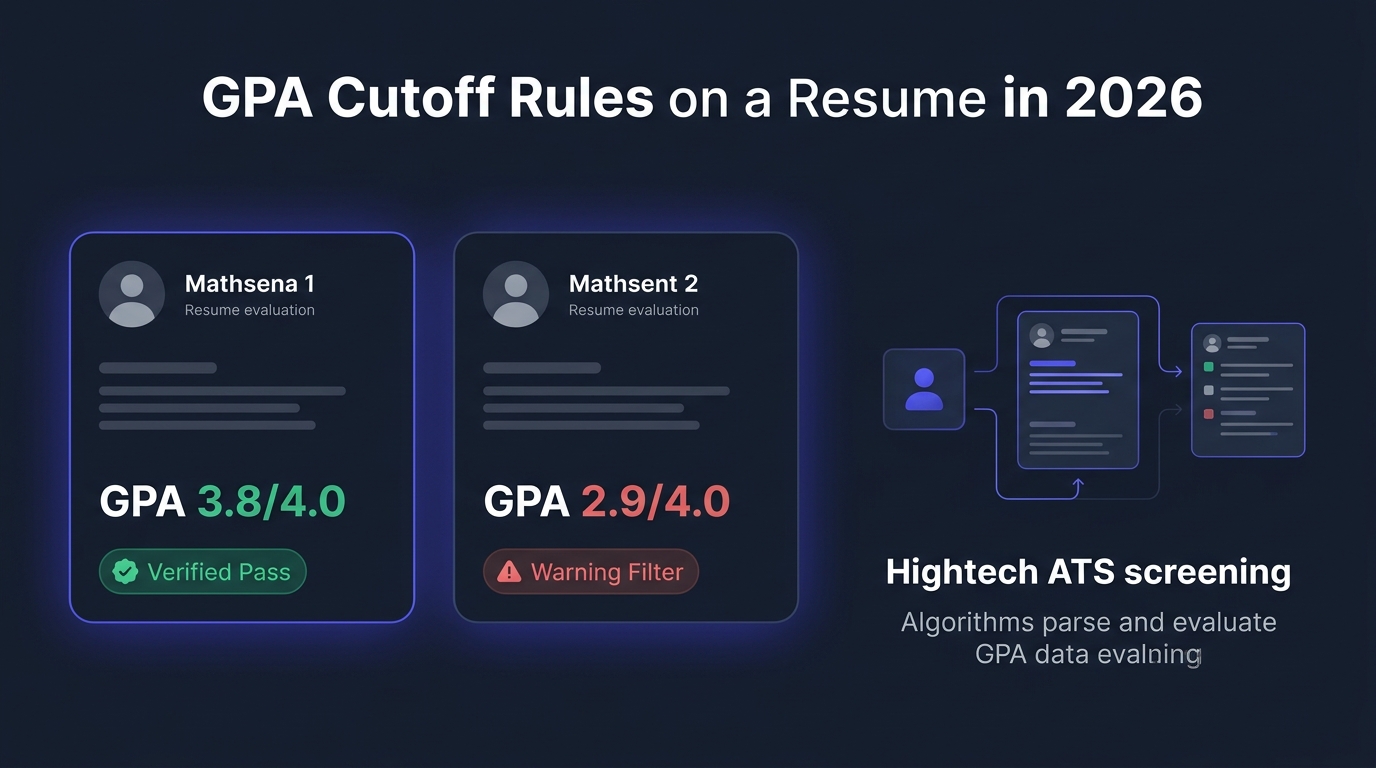
A common misconception among job seekers is that ATS software like Workday, Greenhouse, or Taleo automatically reads your resume PDF and executes an algorithm to disqualify resumes without a GPA line. That is rarely how modern parsers work.
In standard candidate tracking pipelines, ATS parsers extract text tokens into structured candidate records. A numeric GPA written into body text is parsed as a data attribute, but unless the hiring team created a specific hard rule (known as a knock-out question in the portal form), missing numeric values do not trigger auto-rejections.
The true filtering hazard occurs during human resume screening. When a recruiter spends six seconds scanning an entry-level candidate, a low GPA draws immediate negative scrutiny, whereas an omitted GPA allows high-impact internship achievements to take center stage.
4. When Experience Trumps Academic Metrics (The 2-Year Rule)
Your academic grades have an expiration date. In professional hiring markets, hiring managers care about revenue generated, systems deployed, clients served, and problems solved, not how you performed on a sophomore midterm exam.
- Current Students and Recent Grads (0 to 12 Months): GPA can remain on your resume only if it meets the 3.5 threshold and reinforces your qualifications.
- Junior Professionals (1 to 2 Years): Your GPA should be moved beneath your professional experience section or removed entirely once your first corporate role concludes.
- Experienced Candidates (2+ Years): GPA must be completely erased. Retaining an undergraduate GPA past two years of career tenure makes an applicant appear inexperienced and overly reliant on academic identity.
5. What to Highlight When You Leave GPA Off
Omitting your grade point average frees up premium visual real estate on the top third of your resume. Replace academic scores with high-impact evidence of professional capability:
- Quantified Internship Achievements: Focus on results with clear business metrics, such as reducing latency by 24 percent or improving onboarding conversion rates.
- Hands-On Projects and Code Repositories: For technical tracks, links to active GitHub repositories, deployed web applications, or open-source contributions outweigh university transcripts.
- Industry Certifications: Recognized credentials like AWS Certified Solutions Architect, CompTIA Security+, or CFA Level 1 communicate current domain knowledge.
- Dean's List or Academic Honors: If you achieved Dean's List recognition in select semesters despite a moderate cumulative GPA, you can list the honor under your degree without attaching a cumulative number.
Application Portal Knock-Out Questions
If an online employer portal includes an explicit required dropdown or text input asking for your cumulative GPA, always answer truthfully. Discrepancies between application questionnaire submissions and official university transcripts discovered during third-party background checks (such as HireRight or Sterling) can result in revoked offers.
6. Maximizing Your Application Conversion Rate
Unlike mass-apply tools or browser extensions that send an identical resume to every opening, Jobloo generates a tailored resume for each job description before submitting the application. For early-career applicants, tailoring ensures that the specific keywords, technologies, and projects sought by the hiring team are highlighted at the top of your document, rendering academic numbers secondary.
Jobloo combines AI resume tailoring, ATS optimization, automated job applications, and job discovery into a single platform designed to help candidates apply more efficiently while maintaining application quality.
Frequently Asked Questions
What GPA should you put on a resume in 2026?
As a general rule, only list your GPA if it is 3.5 or higher on a 4.0 scale. If your overall GPA is below 3.5 but your major GPA is 3.7 or higher, you can specifically list your Major GPA. Anything below 3.0 should be excluded completely.
Do ATS systems automatically filter out resumes without a GPA?
Unless the employer explicitly configures a knock-out question requiring a numeric GPA input during portal submission (common in investment banking or management consulting campus programs), modern ATS platforms like Greenhouse and Workday do not reject resumes solely for omitting a GPA.
When should you permanently remove GPA from your resume?
Remove your GPA as soon as you have completed your first full-time professional role or accumulated two to three years of work experience. At that stage, measurable workplace accomplishments and technical skills carry far more weight than undergraduate coursework.
